7 Recovery Habits That Matter More Than the Workout Itself After Fifty
Quick Answer: After fifty, muscle recovery takes roughly 24-48 hours longer than it did in your 30s due to slower protein synthesis and connective tissue repair, which means recovery habits — sleep, protein timing, and rest day spacing — do more for your progress than adding extra workouts.
Most strength training advice focuses entirely on the workout itself, but past fifty, what you do between sessions often matters just as much.

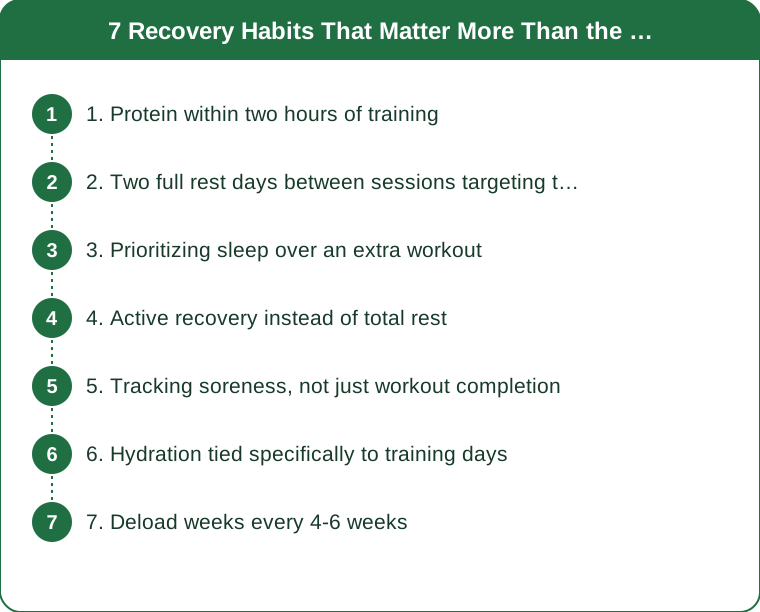
1. Protein within two hours of training
Muscle protein synthesis slows with age, making the post-workout window more important than it was at 30. Aim for 25-30 grams of protein within two hours of finishing, whether that’s a meal or a shake — waiting until dinner several hours later blunts the benefit.
2. Two full rest days between sessions targeting the same muscles
Training the same muscle group on back-to-back days is a common mistake carried over from younger training habits. Spacing 48 hours between sessions hitting the same area gives connective tissue, not just muscle, time to repair — tendons and ligaments recover slower than muscle fibers do.
3. Prioritizing sleep over an extra workout
Skipping a workout for sleep often produces better long-term results than skipping sleep for a workout. 7-8 hours of consistent sleep is when the bulk of muscle repair and growth hormone release happens — a tired body simply can’t recover what a workout breaks down.

4. Active recovery instead of total rest
Complete inactivity on rest days can actually slow recovery by reducing blood flow to sore muscles. A 20-30 minute walk or gentle mobility session on off days keeps circulation moving without adding training stress.
5. Tracking soreness, not just workout completion
Pushing through soreness that lingers past 72 hours is often a sign of inadequate recovery, not toughness. If soreness from Monday’s workout is still sharp on Thursday, that’s a signal to extend rest, not a badge of a good session.
6. Hydration tied specifically to training days
Dehydration slows nutrient delivery to recovering muscle tissue, and thirst cues become less reliable with age. Drinking on a schedule on training days — not just when thirsty — supports the recovery process more directly than most people realize.
7. Deload weeks every 4-6 weeks
Continuous progressive training without a planned lighter week eventually catches up with joints and connective tissue after fifty. A deload week — roughly 50% of normal training volume — every month to six weeks prevents the kind of accumulated fatigue that leads to injury or plateaus.
TL;DR:
- Eat 25-30g protein within two hours post-workout
- Give the same muscle group 48 hours before training it again
- Prioritize 7-8 hours of sleep over squeezing in extra sessions
- Build in a deload week every 4-6 weeks
Recovery isn’t the passive part of training after fifty — it’s arguably the part doing the most work.
Keep Reading
This article is for general informational purposes only and is not medical advice. Always consult a qualified health professional for guidance specific to you.