7 Signs You Need a Deload Week - and Why They Look Different After Fifty
Quick Answer: After fifty, accumulated training fatigue tends to show up in connective tissue, sleep quality and grip strength before it shows up in the gym numbers - which is the opposite of the classic younger-athlete pattern where performance drops first. The seven signs below are the early ones. A deload does not mean stopping: it means roughly half the usual volume at the same or slightly lower intensity for one week, which is enough to clear accumulated fatigue without any loss of adaptation.
The standard advice says to deload when your lifts stall. That advice was written for people whose tendons recover in three days.
After fifty, the signal arrives well before the numbers move - usually in a joint that has started talking, in sleep that has quietly got worse, or in a warm-up that now takes twice as long.
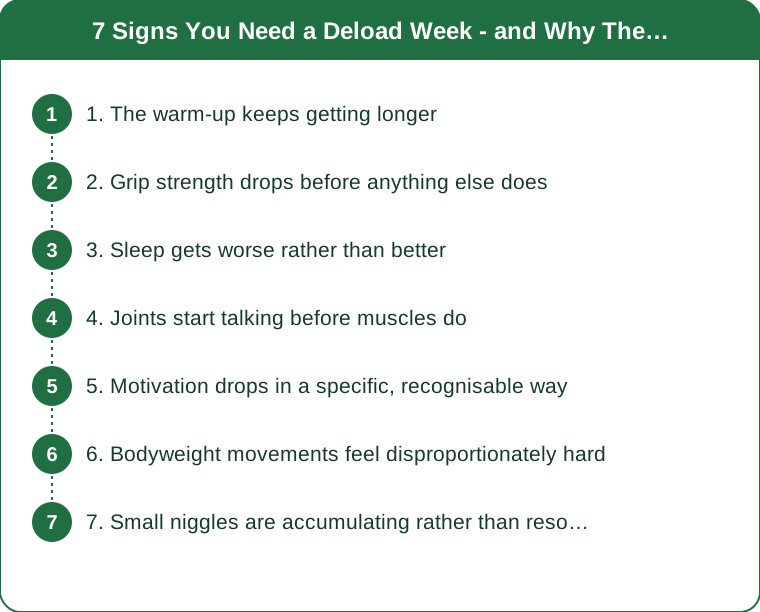
Here are the seven that come first, in roughly the order they appear.

1. The warm-up keeps getting longer
This is usually the earliest signal, and almost nobody counts it as one.
Everyone’s warm-up lengthens somewhat with age - that is a normal, permanent adaptation to changes in tissue compliance and synovial fluid behaviour, and it is not a problem.
What matters is a change in your own baseline. If you needed ten minutes in July and you now need twenty-five to feel ready for the same working weight, that is accumulated fatigue rather than aging. Aging happens over years; this happened over weeks.
The mechanism is that under-recovered tissue is stiffer and less responsive. Muscles that have not fully repaired between sessions carry residual tension, and the tendons and fascia around them are less compliant.
The practical test: track roughly how long it takes before a movement feels normal. Not precisely - just whether it is trending up. A warm-up that has doubled over a month is a deload signal even if every lift is still moving.
This is also a safety signal, not just a performance one. Training on tissue that needs twenty-five minutes to feel ready means a large portion of your session happens on tissue that is not quite there yet, and that is where strains occur.
2. Grip strength drops before anything else does
Grip is the most sensitive available marker of systemic fatigue, and it is easy to check.
Grip strength reflects central nervous system readiness remarkably well - it correlates with overall recovery status better than most single measures, which is why it is used in both sports science and clinical assessment.
When you are under-recovered, grip fatigues faster and maxes out lower, often days before your squat or press shows anything. The everyday version: the shopping bags feel heavier, jar lids get harder, and the last set of a row fails at the hands rather than the back.
How to actually use this: if you have a hand dynamometer, test once a week at the same time of day. Most people do not, so the practical version is noticing whether the same weight of deadlift now needs straps when it did not a month ago.
Why it matters more after fifty: grip strength is also one of the strongest predictors of long-term health outcomes in older adults, so it is worth tracking for its own sake rather than only as a fatigue marker. Watching it weekly gives you both a recovery signal and a genuinely meaningful health metric.
A caution: a persistent grip drop alongside numbness or tingling in the hands is a different problem - nerve rather than fatigue - and warrants a proper look.
3. Sleep gets worse rather than better
Under-recovery raises sympathetic nervous system activity, which disrupts sleep - and disrupted sleep is where most recovery happens.
The intuitive expectation is that hard training produces deeper sleep. That is true up to a point and reverses past it. Accumulated training stress elevates evening cortisol and sympathetic tone, which produces the specific pattern of falling asleep fine and waking at 3 or 4am, wide awake and unable to get back down.
After fifty this matters more for two reasons. Sleep architecture already changes with age - less deep slow-wave sleep, more fragmentation - so there is less margin. And growth hormone release, which is concentrated in deep sleep, is a meaningful part of tissue repair.
So the loop is tight: less recovery capacity produces worse sleep, which produces less recovery, which requires more deload than it would have if caught early.
What to look for: early waking that is new, feeling unrefreshed despite adequate hours, or an elevated resting heart rate on waking. If you track heart rate variability, a sustained downward trend over a week or more is a reliable indicator.
And rule out the obvious first. Menopause-related sleep disruption, alcohol, late caffeine, and a warm bedroom all produce the same pattern. If those are in play, deal with them before concluding it is training load.

4. Joints start talking before muscles do
Connective tissue recovers considerably more slowly than muscle after fifty, so it is the first thing to complain.
Tendons and ligaments have poor blood supply compared with muscle, and both the rate of collagen turnover and tissue elasticity decline with age. The result is a widening gap: your muscles can handle a training frequency that your tendons cannot.
This is the most important structural difference between training at thirty and training at sixty, and it is the reason the classic deload advice does not transfer.
What it feels like: a dull ache in a joint the day after training that was not there before. Elbows after pressing, knees after squatting, the front of the shoulder after anything overhead. Not sharp pain - a low background awareness of a joint you did not used to notice.
Crucially, muscle soreness may be completely normal at this point. Your quads feel fine and your knees feel used. That mismatch is the signal.
Distinguishing fatigue from injury: accumulated tendon fatigue is usually bilateral or moves between joints, is worse the day after and better with gentle movement, and is dull rather than sharp. A single joint, one side, sharp, and worsening is not a deload issue - that is worth getting assessed.
5. Motivation drops in a specific, recognisable way
Not general low mood - a specific reluctance about training that arrives on the way to the gym.
Central fatigue is a real phenomenon with a neurochemical basis, and it presents psychologically before it presents physically. The characteristic pattern is that you feel fine during the day, still want the results, and find yourself unexpectedly negotiating with yourself in the car park.
How to tell it apart from ordinary reluctance:
Ordinary lack of motivation usually lifts once you start - five minutes into the warm-up you are glad you came. Central fatigue does not lift. You warm up, you still feel flat, and the session is a grind throughout.
Another marker: enjoyment of the parts you usually like. If the movements you genuinely enjoy have become tedious, that is a stronger signal than skipping a session you never liked.
Irritability is part of the same picture. Elevated sympathetic tone affects mood regulation, and a period of feeling short-tempered alongside heavy training is a recognised pattern rather than a coincidence.
This is the sign people are most likely to override, because it reads as a character issue rather than a physiological one. It is not - and pushing through central fatigue reliably extends it.
6. Bodyweight movements feel disproportionately hard
When the easy things get hard, the fatigue is systemic rather than local.
A heavy lift being harder could be a lot of things - technique, sleep, food, an off day. But when press-ups, a bodyweight squat, or walking up stairs feels genuinely effortful, that is a whole-system signal.
The stairs test is the most useful informal one available. Everyone climbs stairs regularly enough to have a baseline. If a flight you take every day has started to register, your system is carrying more fatigue than you have accounted for.
Everyday tasks are the honest measure. Carrying shopping, getting off the floor, lifting a case into an overhead locker. These do not vary with motivation the way a gym session does, so they are less contaminated as signals.
And a specific one after fifty: balance degrades under fatigue. Single-leg stability is measurably worse when under-recovered. If you have started putting a hand out during single-leg work you used to do unsupported, that is both a fatigue signal and a fall-risk consideration worth taking seriously.
The practical value here is that these are checks you can run without a gym. Stairs, getting up from a chair without hands, standing on one leg while brushing your teeth. Any of them trending worse over a fortnight is worth a deload.
7. Small niggles are accumulating rather than resolving
One niggle is normal. Three at once, none of them resolving, is a pattern.
Healthy training produces occasional minor complaints that appear and clear within a few days. What signals accumulated fatigue is when they stop clearing and start stacking - a shoulder from two weeks ago that is still there, plus a hip from last week, plus something new in the wrist.
This reflects a system-wide reduction in repair capacity rather than any single tissue problem, which is why treating each one individually does not work.
Track it simply: note anything that hurts and how long it has been there. Three items on the list, or any single item over three weeks, is a deload signal.
What a deload actually is, since this is where people get it wrong:
Reduce volume by roughly half. Keep intensity similar or slightly lower. Same exercises, same rough weights, half the sets. This is important - dropping intensity entirely tends to leave people feeling worse and losing their groove, while dropping volume clears the fatigue.
One week is usually enough, though after fifty some people do better with ten days.
Keep moving. Walking, mobility, easy cardio. Complete rest is less effective than reduced training for clearing accumulated fatigue.
Schedule them rather than waiting for signs. Every four to six weeks after fifty is a reasonable default, and it is far easier than recovering from having gone too far.
And the outcome to expect: most people come back from a proper deload stronger, not weaker. One week at half volume does not reduce fitness - it uncovers the fitness that fatigue was hiding.
General information, not medical advice. Sharp or one-sided joint pain, numbness, or symptoms that worsen despite rest should be assessed by a healthcare professional.
TL;DR:
- After fifty, fatigue shows up in connective tissue, sleep and grip before it shows up in your lifts - the reverse of the classic pattern.
- The seven early signs: lengthening warm-ups, dropping grip, worse sleep, joints aching while muscles feel fine, sticky low motivation, bodyweight tasks feeling hard, and niggles that stack instead of clearing.
- Joints complaining while muscles feel fine is the key mismatch - tendons recover more slowly than muscle.
- A deload is half the volume at similar intensity for one week, not a week off. Keep walking and moving.
- Schedule them every four to six weeks rather than waiting for the signs to appear.
A deload week does not cost you fitness. It reveals the fitness that accumulated fatigue was hiding.
Keep Reading
This article is for general informational purposes only and is not medical advice. Always consult a qualified health professional for guidance specific to you.