7 Signs Your Training Week After Fifty Has Too Much of One Thing
Quick Answer: A monotonous training week after fifty shows up as specific overuse aches, stalled progress in one area while another declines, and joints that hurt in the same place every week. The most common imbalances are too much steady cardio and not enough resistance work, too much pushing and not enough pulling, and no balance or power work at all. A well-rounded week includes two resistance sessions, some higher-intensity work, deliberate balance training, and at least one movement pattern you find awkward.
You have not got worse and you are not overtraining. You have been doing a very similar week for a long time, and the body adapts to exactly what you give it and nothing else.
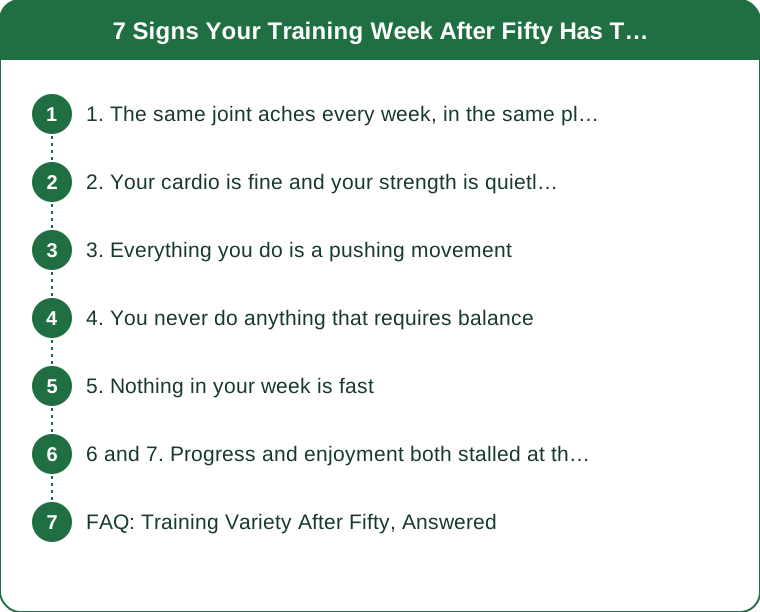
Here are the seven signals that it is variety, not effort, that is missing.

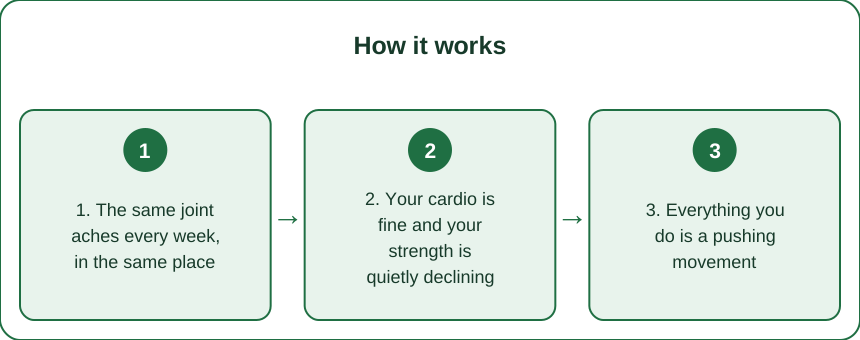
1. The same joint aches every week, in the same place
What it means: repeated identical loading with no variation. Tissue tolerates variety far better than repetition, and an ache that recurs on a schedule is an overuse pattern rather than an injury.
Where it usually shows: shoulders in swimmers and frequent pressers, knees in runners and cyclists, hips in walkers who never change terrain.
The fix: change the movement rather than reducing the volume. Swapping a barbell press for a dumbbell or landmine variation changes the loading angle enough to matter while keeping the training effect.
Why it matters more after fifty: tendon tissue adapts more slowly and recovers more slowly, so the margin for repetitive identical loading is smaller than it was.
When to stop guessing: pain that persists at rest, wakes you at night, or is sharp rather than achy is a different category. This is general information, not medical advice.
2. Your cardio is fine and your strength is quietly declining
What it means: the classic imbalance. Steady cardio is enjoyable, accessible, and habit-forming, and it does very little for the age-related muscle loss that becomes the central issue after fifty.
The signal: you can walk or cycle for an hour comfortably but struggle with a heavy shopping bag, a suitcase into an overhead locker, or getting up from a low chair without hands.
The fix: two resistance sessions a week, non-negotiable, covering the major movement patterns. This is the highest-priority change on this entire list.
How much: general guidance is muscle-strengthening activity on two or more days a week, alongside regular aerobic activity. Most people over fifty are meeting the second and not the first.
What counts: bodyweight, bands, dumbbells, machines, or barbells. The modality matters far less than the fact of progressive resistance.
3. Everything you do is a pushing movement
What it means: press-ups, overhead press, chest press, and triceps work with almost no rowing or pulling. It is an extremely common pattern because pushing exercises need less equipment.
The signal: rounded shoulder posture, aching between the shoulder blades, and shoulders that feel tight in every direction.
The fix: match pulling volume to pushing volume, or exceed it. Band rows, dumbbell rows, and assisted pull-downs are all accessible at home.
Why it compounds with desk work: a day spent with arms forward followed by a training session of pushing reinforces exactly one pattern all day.
Simple audit: count your weekly sets of pushing and pulling. If pushing is more than 1.5 times pulling, that is your first change.

4. You never do anything that requires balance
What it means: every exercise happens on two feet, on a stable surface, in one plane of motion. Balance is trainable and declines without training, and the decline is largely silent until it matters.
The signal: you cannot comfortably stand on one leg for 20 to 30 seconds, or you reach for support putting on socks.
The fix: single-leg work in every lower-body session - split squats, step-ups, single-leg deadlifts - plus deliberate one-legged standing while brushing your teeth.
Why it matters: balance and lower-body power are strong predictors of function and fall risk later, and both respond well to training at any age.
Cheap and effective: thirty seconds per leg, twice a day, at the bathroom sink. It costs nothing and it is genuinely trainable.
5. Nothing in your week is fast
What it means: all training happens at a moderate, controlled tempo. Power - the ability to produce force quickly - declines faster with age than maximal strength does, and it is what catching yourself on a stumble actually requires.
The signal: you feel strong but slow, and quick movements feel unfamiliar or alarming.
The fix: a small amount of intentionally fast concentric work. Fast stand-ups from a chair, step-ups performed briskly, medicine ball throws, or simply pushing the upward phase of a squat quickly.
Volume needed is low: two or three sets of five to eight fast, controlled repetitions, once or twice a week, is a meaningful stimulus.
Safety note: fast concentric, controlled eccentric. This is not about jumping or impact unless that already suits you.
6 and 7. Progress and enjoyment both stalled at the same time
6. Your numbers have not moved in three months
What it means: the stimulus stopped being challenging some time ago. The body adapts to a given load and then maintains, which is fine as a goal and disappointing as an accident.
The fix: change one variable deliberately - load, reps, tempo, or exercise selection - every four to six weeks. Progression after fifty is entirely possible; it just needs to be intentional rather than assumed.
What not to do: add volume to a week that is already monotonous. More of the same thing is the problem, not the solution.
7. You are bored, and you have stopped noticing that you are bored
What it means: motivation is a training variable, and monotony erodes it slowly enough that people attribute the resulting drop-off to age or busyness.
The signal: you skip sessions without a clear reason, or you shorten them without deciding to.
The fix: add one genuinely new thing per season. A class, a different piece of equipment, an outdoor session, a movement you are bad at. Novelty is a legitimate programming input rather than a frivolous one.
And autumn is the natural moment for it. The seasonal shift indoors is when most people’s training week gets re-set anyway - use it deliberately rather than letting it happen by default.
FAQ: Training Variety After Fifty, Answered
How much strength training do I need after fifty?
General guidance is muscle-strengthening activity on two or more days a week covering the major muscle groups, alongside regular aerobic activity. Most people over fifty meet the aerobic part and not the strength part.
Why does the same joint hurt every week?
Repeated identical loading with no variation. Changing the movement - a different angle, grip, or implement - usually resolves it while keeping the training effect. Pain at rest or at night is a different matter worth getting looked at.
Should I train for power at my age?
Yes. Power declines faster than maximal strength with age and it is what a stumble actually demands. Two or three sets of five to eight fast, controlled reps once or twice a week is enough of a stimulus.
How do I know if my week is too repetitive?
Count your weekly sets by movement pattern - push, pull, squat, hinge, carry, balance. If any category is at zero, or pushing exceeds pulling by more than about 1.5 to 1, that is your first change.
How often should I change my programme?
Change one variable - load, reps, tempo, or exercise selection - every four to six weeks. Wholesale programme changes more often than that make it hard to tell what is working.
TL;DR:
- A recurring ache in the same joint every week is a variety problem, not an effort problem - change the movement rather than the volume.
- The most common imbalance after fifty is plenty of cardio and not enough resistance work; two strength sessions a week is the highest-priority fix.
- Match pulling volume to pushing, add single-leg balance work, and include a small amount of intentionally fast movement for power.
- Change one variable every four to six weeks; more of the same is not progression.
- Add one genuinely new thing each season - boredom is a training variable, and autumn is the natural moment to reset.
This is general information, not medical advice.
Keep Reading
This article is for general informational purposes only and is not medical advice. Always consult a qualified health professional for guidance specific to you.