6 Strength Training Rules That Change After Fifty
Quick Answer: After fifty, the biggest changes are recovery time between hard sessions, the need for more thorough warm-ups, and a shift toward more frequent moderate sessions rather than fewer brutal ones. Training intensity does not need to drop — the research is clear that older lifters respond well to genuinely heavy work. What changes is how often you can repeat it and how long the tissue takes to tolerate it.
Six rules, in the order they tend to matter.

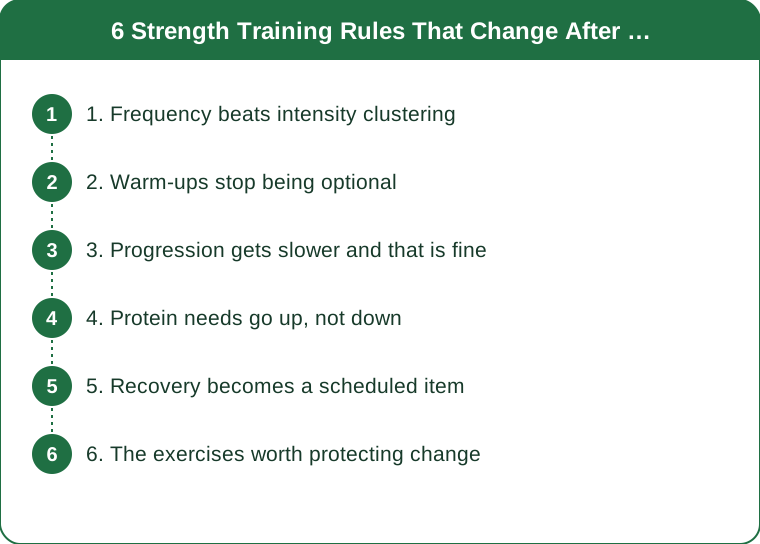
1. Frequency beats intensity clustering
The old model: two enormous sessions a week, each one leaving you wrecked.
Why it stops working: muscle protein synthesis in response to a training stimulus is somewhat blunted after fifty — often described as anabolic resistance. A single very hard session does not produce proportionally more adaptation, and it does produce proportionally more recovery cost.
The adjustment: three or four moderate sessions rather than two maximal ones. The same weekly volume, distributed. Each muscle group hit twice a week rather than once.
What this looks like in practice: instead of a two-hour leg day that ends your week, two 45-minute lower-body sessions on Monday and Thursday. Same total sets, considerably better outcomes, and you can walk on Tuesday.
2. Warm-ups stop being optional
The change: connective tissue — tendons, ligaments, fascia — becomes stiffer and less hydrated with age, and it takes longer to reach working temperature than muscle does.
Why it matters: the tissue that fails in most over-fifty training injuries is tendon, not muscle. A tendon that has not been progressively loaded before the first heavy set is taking the full jump cold.
The adjustment: ten minutes minimum. Five minutes of general movement to raise temperature, then three ramping sets of the first exercise — 40%, 60%, 80% of the working weight — before the first real set.
Where people cut corners: the second and third exercises of a session. A shoulder that was warm for the bench press is not necessarily warm for overhead work fifteen minutes later. One ramp set per new movement pattern is worth the ninety seconds.
3. Progression gets slower and that is fine
The change: adding weight every session works for a novice at any age, but the runway is shorter after fifty because recovery caps how fast you can accumulate hard work.
The adjustment: progress in smaller increments and over longer cycles. 1.25kg jumps rather than 2.5kg on upper body lifts. Adding a rep before adding weight. Expecting a month between load increases on a main lift rather than a week.
A useful frame: you are not trying to get strong by Christmas. You are trying to be strong at seventy-five. Progression at 2kg a month on a squat is 24kg a year, which is an enormous amount of strength.
What breaks people: running a young lifter’s linear programme, stalling in week six, and concluding that lifting no longer works. The programme did not fit; the training did.

4. Protein needs go up, not down
The change: because of anabolic resistance, the amount of protein needed to trigger muscle protein synthesis in a single meal is higher after fifty than it was at thirty. The leucine threshold rises.
The adjustment: aim for 30-40g of protein per meal rather than spreading a small amount across the day, and target roughly 1.6-2.0g per kg of bodyweight daily if you are training seriously. For a 65kg woman, that is around 105-130g.
The practical problem: most people over fifty eat a protein-light breakfast, which wastes the meal from a muscle-building perspective. Moving 25g of protein from dinner to breakfast, changing nothing else, is one of the highest-value adjustments available.
A caution: anyone with kidney disease should discuss protein targets with their clinician rather than following general guidance. This is general information, not medical advice.
5. Recovery becomes a scheduled item
The change: sleep architecture shifts with age — deep sleep declines — and deep sleep is when most of the growth hormone release and tissue repair happens. The same session therefore takes longer to recover from, through no fault of your effort.
The adjustment: treat sleep as part of the programme rather than as what happens after it. Fixed wake time, a cooler bedroom, and a caffeine curfew around 2pm do more for training outcomes at this age than any supplement.
Add a genuine deload. One week in every six or eight at roughly 60% of normal volume. Younger lifters can often skip these; after fifty they are where the accumulated stiffness resolves.
Watch the joints, not the muscles, for overreaching signals. Muscle soreness is a poor indicator. Persistent morning joint stiffness that lasts more than an hour, or a niggle that is present at the start of a session rather than the end, is the reliable early warning.
6. The exercises worth protecting change
What matters most at this age: loaded carries, hip hinges, single-leg work, and pulling. These map directly onto the things that determine independence later — carrying shopping, getting off the floor, catching a stumble, and posture.
What matters less: maximal bench press, isolation arm work, and anything where the risk profile is high and the transfer is low. Not forbidden, just lower priority when time is limited.
Add balance work, genuinely. Single-leg stands, progressing to eyes closed, then to an unstable surface. Two minutes a day. Falls are the single largest threat to long-term independence and balance is highly trainable at any age.
Do not drop heavy work. This is the most common and most costly mistake. Sets of 5-8 at a genuinely challenging load are well tolerated, well evidenced, and produce the bone density and neural adaptations that light circuits do not. Heavy does not mean reckless — it means loaded properly, with good technique, after a real warm-up.
And the rule underneath all six: consistency over years is the variable that dominates. Every adjustment above exists to keep you training next month.
TL;DR:
- Spread volume across three or four moderate sessions rather than two maximal ones.
- Warm up for ten minutes with ramp sets — tendon, not muscle, is what usually fails.
- Progress in smaller increments over longer cycles; a month between load jumps is normal.
- Raise protein to 30-40g per meal, especially at breakfast.
- Schedule sleep and a deload every six to eight weeks, and watch joints rather than soreness for warning signs.
- Prioritise carries, hinges, single-leg work, pulling, and balance — and keep lifting genuinely heavy.
None of this is about training less. It is about arranging the same work so your body can keep repeating it.
Keep Reading
This article is for general informational purposes only and is not medical advice. Always consult a qualified health professional for guidance specific to you.