The Strength Training Injury-Prevention Rules That Actually Matter More After Fifty
Quick Answer: After fifty, warmup duration, joint-specific mobility work, and progressive loading matter more for injury prevention than they did in your thirties, largely because tendons and connective tissue recover more slowly and adapt to new loads less quickly — the training itself doesn’t need to be dramatically different, just the preparation around it.
The strength training itself is still safe and highly beneficial at this stage — it’s the surrounding habits that need updating, more than the exercises.

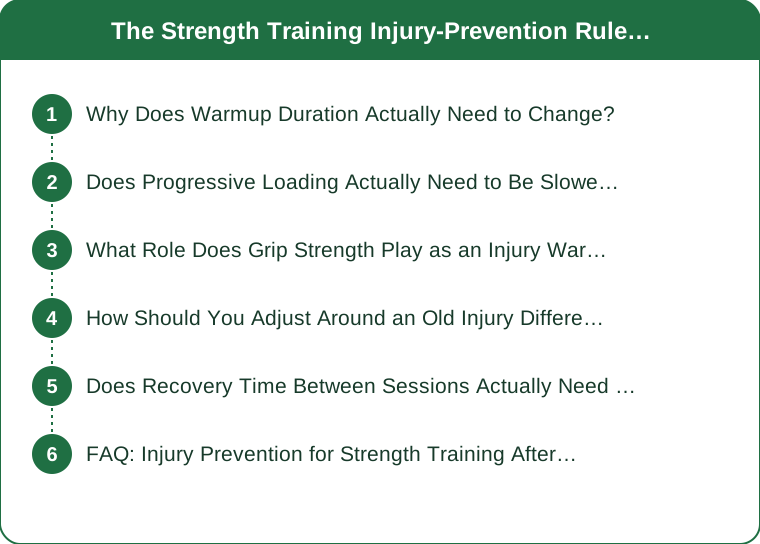
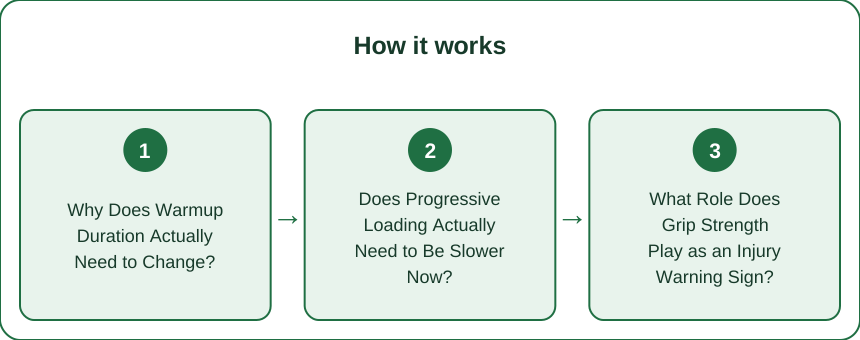
Why Does Warmup Duration Actually Need to Change?
Tendons and ligaments take longer to reach full elasticity and blood flow readiness with age, meaning a warmup that was adequate at 30 may not sufficiently prepare joints for loading at 55. Extending warmup time — aiming for 10-15 minutes of progressive movement and light sets before working weight, rather than 5 — gives connective tissue the extra time it now needs to be genuinely ready for load.
Does Progressive Loading Actually Need to Be Slower Now?
Generally yes, though not dramatically. Tendons adapt to new loads more slowly than muscle does at any age, and this gap widens somewhat after fifty — muscle strength can outpace tendon readiness if you increase weight too quickly, creating a mismatch that’s a common source of tendon-related injuries in this age group specifically. Smaller, more gradual weight increases (perhaps 2.5-5% rather than jumping larger increments) reduce this risk.
What Role Does Grip Strength Play as an Injury Warning Sign?
Grip strength is increasingly used as a marker of overall physical resilience and recovery capacity after fifty. A noticeable, sustained drop in your usual grip strength or a harder time completing sets you’d normally handle easily can be an early signal of accumulated fatigue or inadequate recovery — worth treating as a cue to scale back intensity that week rather than pushing through.

How Should You Adjust Around an Old Injury Differently Now?
An old injury that felt fully resolved in your thirties may need more ongoing, proactive management after fifty — reduced tissue elasticity around old scar tissue or previously injured joints means these areas are more prone to re-aggravation under new loading patterns. Building in specific mobility and activation work for previously injured areas before general training, rather than treating them as fully behind you, tends to prevent recurring issues.
Does Recovery Time Between Sessions Actually Need to Change?
Often yes — recovery from strength training sessions genuinely takes somewhat longer after fifty due to slower tissue repair processes, and pushing the same training frequency that worked at 35 without adjusting recovery time is a common source of overuse injuries in this age group. Adding an extra rest day between sessions targeting the same muscle groups, or alternating higher and lower intensity days, tends to reduce injury risk without meaningfully reducing strength gains.
FAQ: Injury Prevention for Strength Training After Fifty Questions, Answered
Does this mean I need to lift lighter overall after fifty?
Not necessarily — the goal is adjusting how you progress and recover, not artificially capping how much you can eventually lift; many people continue increasing strength well past fifty with these adjustments in place.
Is joint pain during a workout always a sign to stop immediately?
Sharp or worsening pain warrants stopping and evaluation; general workout fatigue or mild muscle soreness is different and doesn’t require the same caution — knowing the difference matters, and a doctor or physical therapist can help you learn to distinguish them if you’re unsure.
Should I work with a trainer specifically experienced with this age group?
It can help significantly, particularly for learning appropriate progression pacing and form cues specific to age-related tissue changes, though it’s not strictly required if you’re already applying these principles carefully on your own.
TL;DR:
- Longer warmups (10-15 minutes) give slower-adapting connective tissue the readiness time it now needs
- Smaller, more gradual load increases reduce the mismatch between muscle and tendon adaptation speed
- Watch grip strength and recovery as signals to scale back intensity when needed
- Old injuries may need proactive, ongoing management rather than being treated as fully resolved
None of this means training less — it means training a little smarter around how your body’s recovery has genuinely changed.
Keep Reading
This article is for general informational purposes only and is not medical advice. Always consult a qualified health professional for guidance specific to you.