7 Training Adjustments Worth Making After 50 as the Season Turns
Quick Answer: After 50, the seasonal transition affects warm-up length, tendon readiness, vitamin D status, protein timing, recovery duration, balance training and daily step count - all at once. The adjustments below are additions rather than reductions: a longer warm-up, more protein per meal, an extra recovery day between hard sessions, and deliberate balance work to replace what summer supplied incidentally. Training volume rarely needs to drop; the supporting structure around it does need to change.
The one people skip is the warm-up, and it is the one with the clearest injury consequence.
This is general information rather than medical advice. Check with a doctor before starting a new programme.

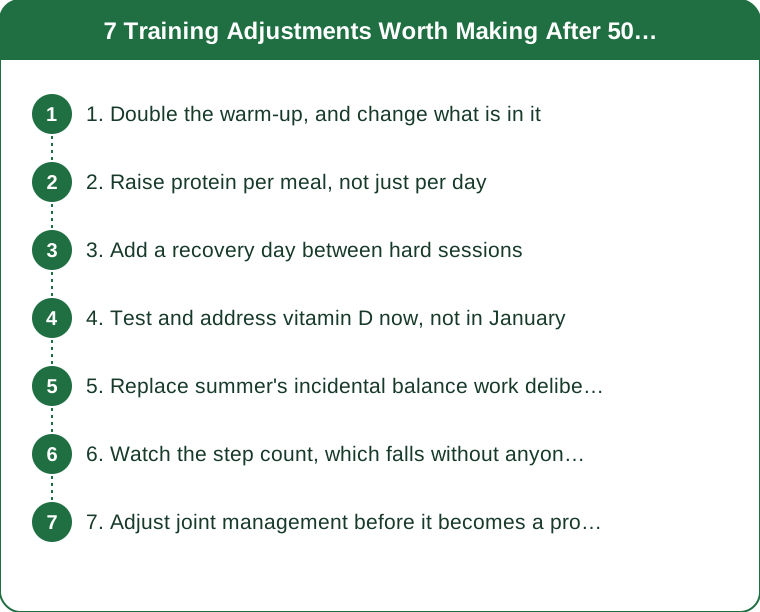
1. Double the warm-up, and change what is in it
The most important adjustment on this list and the one most often shortened.
Why it matters more now. Tendons and connective tissue become less compliant with age and with lower temperature, and both effects compound in autumn. Cold tissue is stiffer, transmits force differently, and is more prone to strain.
The changes:
- 10 to 15 minutes rather than 5, and it is not optional in cooler weather
- General warming first - 5 minutes of walking, cycling or rowing to raise core and tissue temperature. This is the part that actually matters and the part usually skipped
- Dynamic mobility second, not static stretching. Leg swings, arm circles, controlled squats, hip circles
- Movement-specific ramp-up third. Two or three progressively loaded sets of the first exercise before the working sets
What to drop. Long static stretching before training, which temporarily reduces force production and does not prevent injury.
The specific autumn issue. A cold gym, a cold car journey, and a cold morning mean you arrive with lower tissue temperature than you did in July. The warm-up has to make up that difference before it starts doing its normal job.
A practical marker. You should be lightly sweating and slightly breathless before the first working set. If you are not, the warm-up was not long enough, regardless of what the clock said.
2. Raise protein per meal, not just per day
Distribution matters more after 50 than total intake does, and this is well established.
Anabolic resistance. Older muscle responds less strongly to a given dose of protein. The threshold to trigger muscle protein synthesis rises with age - where a younger adult may respond to around 20g of high-quality protein, older adults typically need 30 to 40g per meal.
What this means practically:
- Total daily protein of roughly 1.2 to 1.6g per kg of body weight for active adults over 50, higher than general population guidance
- Spread across 3 to 4 meals of 30 to 40g each, rather than concentrated at dinner
- Breakfast is where most people fall short - a typical breakfast delivers under 15g, which is below the threshold to trigger a response at all
Practical amounts:
- A large egg is about 6g, so a three-egg breakfast is 18g and still short. Add Greek yogurt, cottage cheese, or milk
- 150g of Greek yogurt is around 15g
- A palm-sized portion of meat or fish is roughly 25 to 30g
- Legumes and grains contribute meaningfully but require larger volumes and combination
Leucine specifically. The amino acid that triggers the response. Around 2.5 to 3g of leucine per meal is the practical target, which is what a 30 to 40g dose of a complete protein delivers.
Timing around training. Protein within a few hours either side of resistance training is beneficial. The exact window matters far less than hitting the per-meal threshold consistently, which is where the real gains are.
3. Add a recovery day between hard sessions
Recovery duration extends with age, and the season adds to it.
What changes. Muscle protein synthesis remains elevated for a shorter period after training, and markers of muscle damage take longer to normalise in older adults. Both point the same way: more time between hard sessions targeting the same tissue.
The practical structure:
- 48 to 72 hours between hard sessions for the same muscle group, rather than 48
- Three quality strength sessions a week beats four mediocre ones, and the difference widens with age
- Fill the gap with movement rather than rest - walking, mobility, easy cardio. Complete rest days are less useful than active ones
Why autumn compounds it:
- Less daylight means less incidental activity, so total load drops while training load stays the same - which sounds like it should help recovery and instead reduces the circulation and movement that assist it
- Schedule changes reduce sleep, and sleep is the single most important recovery variable at any age
- Cooler temperatures increase stiffness, which reads as incomplete recovery
Signs you need more recovery, not more discipline:
- Performance declining across sessions rather than improving
- Elevated resting heart rate in the morning
- Persistent joint ache rather than muscle soreness
- Poor sleep despite adequate opportunity
The counterintuitive point. After 50, the limiting factor on progress is much more often recovery than training stimulus. Adding a rest day frequently produces better results than adding a session.

4. Test and address vitamin D now, not in January
Levels decline from autumn and the decline starts before anyone thinks about it.
Why it matters for training. Vitamin D is involved in muscle function, bone health and immune function. Deficiency is associated with muscle weakness, increased fall risk and worse bone density - all more consequential after 50.
The seasonal pattern. At latitudes above roughly 37 degrees, the sun is too low from around October to March for the skin to synthesise meaningful vitamin D. Levels typically peak in late summer and decline through winter, reaching their lowest in late winter.
Which means now is the peak. If your level is marginal in late August, it will be low by December. Testing now gives a far more useful picture than testing in January, and it is the reason this belongs on an autumn list rather than a winter one.
What to do:
- Ask for a 25-hydroxyvitamin D test, particularly if you are over 50, have darker skin, cover up outdoors, or spend most of the day inside
- Many health bodies recommend a supplement through autumn and winter for the general population, with 10 micrograms (400 IU) daily a common baseline recommendation
- Higher doses should follow a test result, not a guess
- Take it with a meal containing fat, since absorption is fat-dependent
Calcium alongside it. Vitamin D supports calcium absorption, and bone density loss accelerates in the years around and after menopause. Adequate calcium plus resistance training plus vitamin D is the combination with the best evidence for bone health.
5. Replace summer’s incidental balance work deliberately
Summer supplies balance training accidentally. Autumn removes it, and nobody notices.
What summer provided. Uneven ground - grass, sand, trails, gardens. Varied surfaces are continuous balance training, and they disappear from most people’s lives when the weather turns and activity moves indoors.
Why balance deserves specific attention after 50. Balance declines measurably from midlife, and falls are the leading cause of injury in older adults. Balance is highly trainable at any age, and it responds quickly - meaningful improvement within weeks.
A practical progression, 5 minutes daily:
- Single-leg stand, 30 seconds each side. Near a counter for support. Progress by closing your eyes, which removes visual input and increases difficulty substantially
- Tandem stance - one foot directly in front of the other, 30 seconds each way
- Heel-to-toe walking, 10 steps
- Single-leg stand while moving your head side to side, which challenges the vestibular system
- Step-ups onto a low step, controlled down, which combines strength and balance
Where to put it. Attach it to something you already do daily - while the kettle boils, while brushing teeth. Five minutes of daily practice beats a longer weekly session by a wide margin.
A useful self-test. Timing a single-leg stand with eyes open gives a rough benchmark. If you cannot hold 10 seconds on either leg, that is worth addressing directly and worth mentioning to a doctor or physiotherapist.
6. Watch the step count, which falls without anyone deciding
Daily activity outside training drops substantially in autumn, and it matters more than the training does.
The size of the effect. Daily step counts commonly fall by 1,500 to 3,000 steps from summer to autumn as daylight shortens and outdoor time drops. Nobody makes this decision; it happens.
Why it matters after 50:
- Non-exercise activity is a large fraction of total daily energy expenditure, often larger than structured training
- Prolonged sitting has health effects independent of exercise volume, so a good gym session does not offset a sedentary day
- Reduced walking means reduced load on bone, which matters for density
What to do about it:
- Measure it. Most phones already do. The drop is invisible without measurement and obvious with it
- Set a floor, not a target. A minimum you meet on the worst day, which for many people is 6,000 to 7,000 steps
- Front-load walking into the morning, since afternoon daylight disappears first
- Break up sitting every 30 to 45 minutes, which has independent benefits
The most reliable autumn strategy. A fixed daily walk attached to an existing event - after breakfast, after the evening meal - rather than an intention to walk more. Intentions to walk more do not survive shorter days.
7. Adjust joint management before it becomes a problem
Cool weather changes joint symptoms, and the response should be proactive rather than reactive.
What actually happens. Many people report increased joint stiffness and ache in cooler, damper weather. The mechanism is not fully established - proposed explanations include barometric pressure effects on joint tissue and reduced activity levels - but the experience is common and consistent enough to plan around.
The practical adjustments:
- Move earlier in the day rather than later if morning stiffness is the issue. Gentle movement on waking reduces morning stiffness more effectively than resting through it
- Warmth before training. A warm shower before a morning session genuinely helps, and it is the cheapest intervention available
- Keep joints moving through full range daily, even on non-training days. Range of motion is lost quickly and regained slowly
- Do not reduce loading. Progressive resistance training is one of the best-evidenced interventions for osteoarthritis symptoms. The instinct to protect a sore joint by not loading it makes it worse over months
On footwear, which changes now. Moving from summer shoes to autumn ones changes heel drop and support, which alters load through the knee and hip. Transition over two weeks rather than a single day.
What warrants professional input rather than self-management:
- Joint swelling, warmth or redness, which is different from stiffness
- Pain that wakes you at night
- A joint giving way or locking
- New joint pain accompanied by fatigue or feeling generally unwell
The overall principle for this list. After 50, the training itself usually needs the least adjustment. Warm-up, protein, recovery, balance and daily movement need the most - and all five are things that summer was quietly supplying for free.
TL;DR:
- Double the warm-up to 10 to 15 minutes and start with general warming, not stretching
- Aim for 30 to 40g of protein per meal, not just a daily total - breakfast is where most people fall short
- Allow 48 to 72 hours between hard sessions and fill the gap with movement rather than rest
- Test vitamin D now while levels are at their annual peak, not in January when they are lowest
- Replace summer’s incidental balance work with 5 deliberate minutes daily, attached to an existing habit
None of these are about training less. They are about rebuilding the support structure that a warm active summer was providing without you noticing.
Keep Reading
This article is for general informational purposes only and is not medical advice. Always consult a qualified health professional for guidance specific to you.