7 Things That Change About Warming Up After Fifty
Quick Answer: After fifty the warm-up needs to be longer, more gradual, and more specific - typically 12 to 20 minutes rather than 5. The main drivers are slower tendon and connective tissue response, reduced synovial fluid viscosity at rest, a slower cardiovascular ramp, and joint-specific stiffness that varies by day. Skipping or shortening it does not cause immediate injury; it causes a slow accumulation of tendon irritation that shows up months later.
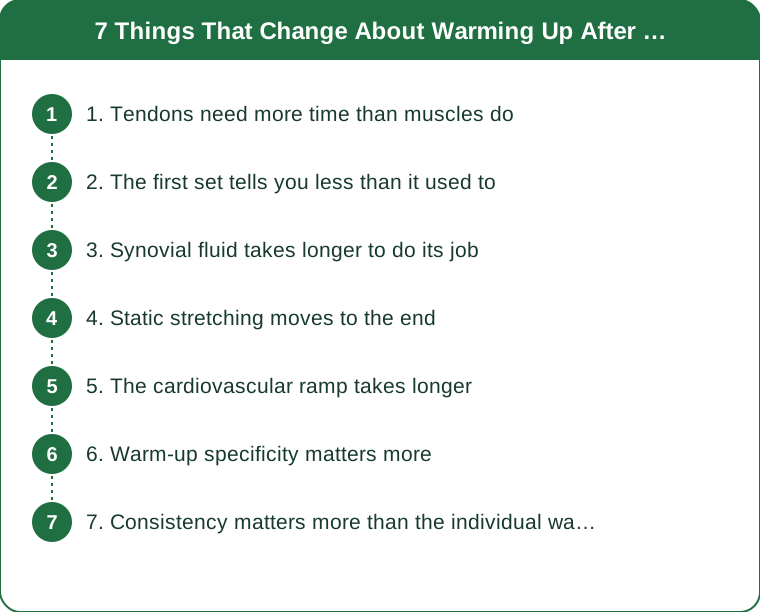
Seven specific changes, and what to do about each.

1. Tendons need more time than muscles do
This is the central change and it drives most of the others.
Muscle and tendon warm up at different rates, and they always have. Muscle responds quickly to increased blood flow and temperature - a few minutes gets most of the available change. Tendon is far less vascular and responds more slowly, and that difference widens with age.
Tendon also changes structurally over time. Collagen turnover slows, cross-linking increases, and the tissue becomes stiffer and less compliant. A stiffer tendon transmits force differently and tolerates sudden loading less well.
The practical consequence is that the point at which your muscles feel ready arrives well before the point at which your tendons are ready. At 30 that gap was small enough to ignore. At 55 it is not.
What this means for the warm-up:
- Extend the general portion to at least 8 to 10 minutes before any loaded work.
- Include more submaximal loaded sets. Tendon responds to graded load specifically, not just to temperature. Three or four ramp-up sets rather than one.
- Do not judge readiness by how the muscle feels. It will feel ready first, every time.
This is also why the injuries that appear in this decade are disproportionately tendon injuries - Achilles, patellar, rotator cuff, elbow - rather than muscle strains. The tissue that warms up slowest is the tissue that gets hurt.
2. The first set tells you less than it used to
Day-to-day variability increases, and one light set is no longer enough information.
At 30, how you feel in the first warm-up set is a reasonable predictor of the session. After 50, joint stiffness and readiness vary considerably more between days - influenced by sleep, previous day’s activity, hydration, and for many people the weather.
Which means the useful warm-up becomes diagnostic as well as preparatory. You are gathering information about what this particular body can do today, not just raising temperature.
A practical structure:
- Set 1, very light: does anything hurt? Note it, do not judge yet.
- Set 2, light: has it improved with movement? Most benign stiffness improves. Pain that worsens with warming is different information.
- Set 3, moderate: is the movement pattern normal, or are you compensating?
- Set 4, near working weight: confirm speed and control.
By set four you have a genuine read. Deciding to modify a session based on set four is good practice. Deciding based on set one is usually premature - a great deal of morning stiffness resolves entirely by the third set.
The corollary is worth stating: a session you modify is not a failed session. The most common route to a long layoff in this decade is pushing through a warm-up that was telling you something.
3. Synovial fluid takes longer to do its job
The joint lubrication mechanism is real, and it is slower than it was.
Synovial fluid becomes less viscous and circulates more effectively with movement - it is a non-Newtonian fluid whose behaviour changes with motion. At rest, particularly after a night’s sleep or a long period sitting, it is thicker and distributes less well.
With age, synovial fluid volume and quality both decline somewhat, and cartilage becomes less efficient at the compression-and-rebound cycle that moves nutrients into it. Cartilage has no blood supply - it is fed entirely by this pumping action - so the warm-up is doing genuine nutritional work for the joint, not only mechanical preparation.
What this favours:
- Full range of motion movements early, unloaded or very lightly loaded. Bodyweight squats to full depth, arm circles through complete range, hip circles. The range is the point.
- Repetition over duration. 15 to 20 slow controlled reps through full range does more for joint preparation than two minutes of holding a stretch.
- Movement in multiple planes, not just the sagittal plane your main lifts use. Rotation and lateral movement prepare tissue that a straight-ahead warm-up misses entirely.
The morning versus evening difference is largest here. If you train early, the warm-up needs to be longer than the same session in the afternoon - often by five minutes or more.

4. Static stretching moves to the end
The evidence here has been settled for a while, and the change matters more with age.
Prolonged static stretching before strength training produces a temporary reduction in force output - typically in the region of a few percent, with the effect larger for holds beyond about 60 seconds. It also temporarily reduces the tendon’s stiffness, and tendon stiffness is part of what protects the joint under load.
So the traditional sequence of sitting down and stretching before lifting is, if anything, counterproductive.
What replaces it:
- Dynamic movement before: leg swings, walking lunges, arm circles, controlled rotations. Movement through range, not held positions.
- Static stretching after, where it is genuinely useful for maintaining range and where the temporary force reduction costs nothing.
The nuance for anyone over fifty: if a specific joint is genuinely restricted in a way that prevents safe positioning - a shoulder that cannot reach the bar, an ankle that will not allow a squat - then a short, targeted static stretch before is justified. Being unable to reach a safe position is a bigger problem than a small temporary force reduction.
Keep those pre-session holds short, under 30 seconds, and targeted at the specific restriction rather than a general full-body routine.
5. The cardiovascular ramp takes longer
Heart rate responds more slowly, and pushing through that produces an unpleasant and unnecessary experience.
Maximum heart rate declines with age at roughly one beat per year, and more importantly, the rate of heart rate increase at the start of exercise slows. The cardiovascular system takes longer to shift blood flow toward working muscle.
Going hard before that shift has happened produces the specific feeling of being disproportionately out of breath in the first few minutes and then feeling fine later. That is not poor fitness - it is a slower ramp.
What works:
- 5 to 8 minutes of easy cardiovascular work before anything demanding, at a genuinely easy pace.
- A gradual build within it rather than a fixed pace - start very easy and increase over the period.
- Accept that the first working set feels harder than the second. This is nearly universal and is the ramp completing, not a warning sign.
This also has implications for the second point about diagnostics. Judging your capacity before the cardiovascular ramp is complete will systematically underestimate what you can do.
6. Warm-up specificity matters more
General warm-ups are less sufficient than they were, and the gap is filled by movement-specific preparation.
A general warm-up raises temperature and heart rate. A specific warm-up rehearses the exact movement pattern under progressively increasing load, which does two things that general work does not: it prepares the specific tendons and joints under the specific angles they will be loaded at, and it re-establishes motor patterning.
That second part becomes more relevant with age. Motor unit recruitment efficiency declines somewhat, and the coordination of a complex lift benefits measurably from rehearsal before load.
What this looks like:
- Ramp sets on every main lift, not just the first. Four sets from empty bar to working weight on the squat, then a separate ramp on the press.
- The same movement, not an approximation. If the session includes overhead pressing, warm up by pressing, not only by doing shoulder circles.
- Slower tempo on ramp sets than working sets, to give the tissue and the pattern time.
The cost is time - a properly specific warm-up on a three-lift session can take 15 minutes. The realistic trade is to reduce total working volume slightly rather than to cut the warm-up, because the working sets you do will be better and the risk profile is substantially different.
7. Consistency matters more than the individual warm-up
The largest protective factor is not what you do before a session. It is how recently you did the movement at all.
Tissue tolerance is use-dependent. A tendon loaded regularly maintains its capacity. A tendon that has not been loaded in three weeks has measurably reduced tolerance, and no warm-up fully compensates for that on the day.
Which means the highest-risk session in this decade is the first one back - after a holiday, an illness, a busy fortnight. That session needs both a longer warm-up and reduced load, and the reduced load is the more important half.
A reasonable return protocol:
- After 1 to 2 weeks off: return at roughly 80 percent of previous working weight, full warm-up, build back over 2 weeks.
- After 3 to 4 weeks: 60 to 70 percent, build back over 3 to 4 weeks.
- After longer: treat it as starting a new block, not resuming an old one.
The other half of consistency is frequency over intensity. Three moderate sessions a week maintains tissue tolerance far better than one hard session, and the warm-up requirement for each is lower because you are never far from the last exposure.
This is the genuinely good news in this list. The warm-up gets longer, but the thing that protects you most is simply not stopping. This is general information, not medical advice - persistent joint pain warrants a professional assessment rather than a longer warm-up.
TL;DR:
- Tendons warm up slower than muscles and the gap widens with age - your muscles will feel ready before your tendons are.
- Use the warm-up diagnostically: four ramp sets, and judge readiness at set four rather than set one.
- Full range of motion movement early feeds cartilage, which has no blood supply and depends on the pumping action.
- Static stretching goes after the session; use dynamic movement before, with short targeted holds only for a genuine restriction.
- Allow 5 to 8 minutes of easy cardio - the heart rate ramp is slower and the first working set will feel harder than the second.
- The first session back after time off is the highest-risk one; reduce load, not just warm-up length.
Budget 12 to 20 minutes and take it out of working volume, not out of preparation. This is general information, not medical advice.
Keep Reading
This article is for general informational purposes only and is not medical advice. Always consult a qualified health professional for guidance specific to you.