Why Grip Strength Might Be the Most Honest Fitness Number You Have After 50
Quick Answer: Grip strength correlates strongly with overall muscle mass and functional independence after 50, which is why researchers use it as a quick proxy for full-body strength. You can meaningfully improve it in 8–12 weeks with farmer’s carries and dead hangs 2–3 times a week — it responds faster than most people expect.
You can lift, you can walk your miles, but nobody mentioned your grip until a doctor handed you a dynamometer and raised an eyebrow at the number. Here’s why that squeeze test matters more than it seems.

Why do researchers use grip strength as a health marker at all?
Grip strength is easy to measure precisely, but what makes it useful is that it correlates closely with total body muscle mass and neuromuscular function — the same systems that decline together as we age. A weak grip in your 50s and beyond is associated with a higher risk of falls, slower recovery from illness, and reduced day-to-day independence, not because your hands specifically matter that much, but because a weak grip usually signals broader muscle loss.
It’s a proxy, not a diagnosis — but it’s a fast, honest one.
What’s a reasonable grip strength target after 50?
General benchmarks put a healthy grip strength for women in their 50s in the range of roughly 20–30 kg on a hand dynamometer, though individual variation is wide. What matters more than hitting an exact number is the trend over time — a grip that’s declining year over year is a stronger signal than any single reading.
Many gyms and physical therapy offices have a dynamometer you can test on for free; ask if you want a real baseline instead of estimating.
How do you actually train grip strength after 50?
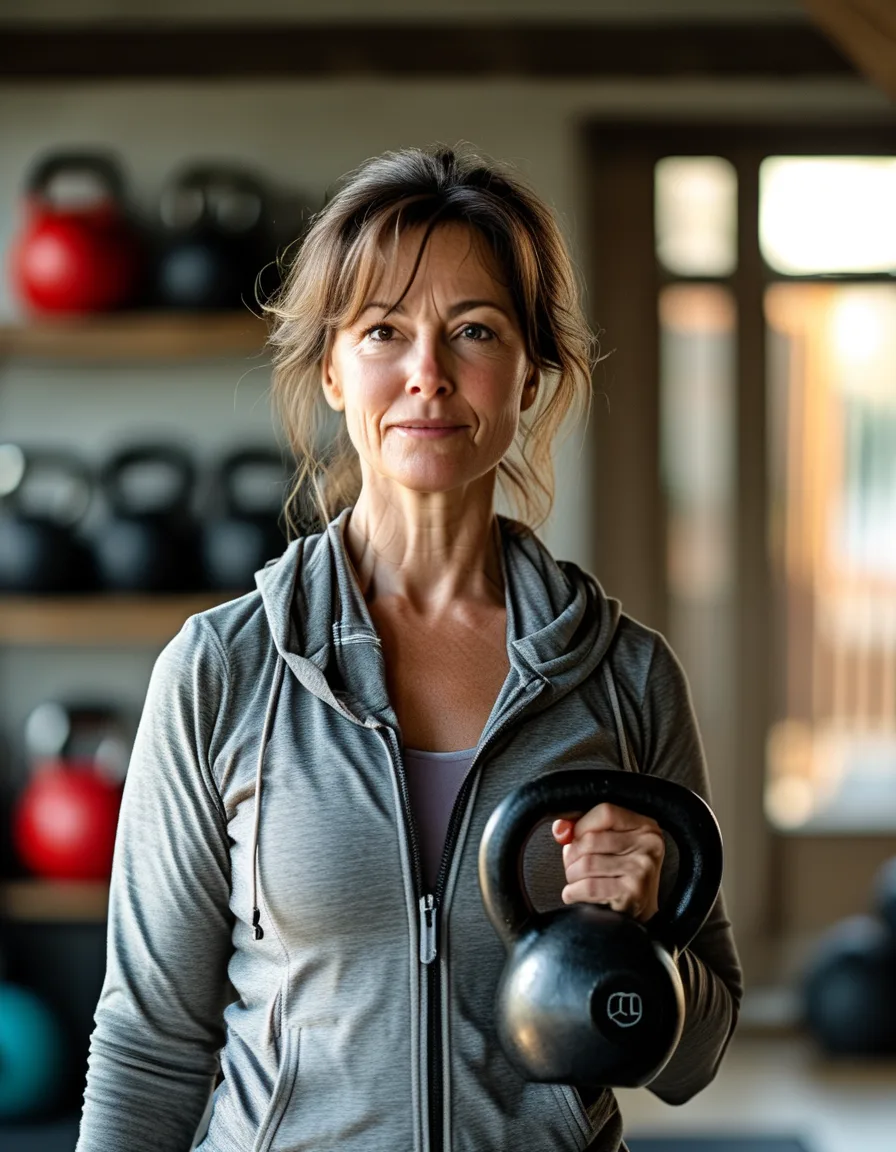
Farmer’s carries are the most efficient tool: hold a heavy dumbbell or kettlebell in each hand and walk for 30–40 seconds, 3 sets, 2–3 times a week. Dead hangs from a pull-up bar (even 10–20 seconds at a time, building up) train grip endurance directly and also decompress the spine as a bonus.
Most people see a measurable improvement within 8–12 weeks of consistent training — grip strength responds relatively quickly compared to larger muscle groups, which makes it a satisfying place to see early progress.
Myth vs Fact: A weak grip is just about hand strength
Myth: If your grip is weak, the fix is squeezing a stress ball more often.
Fact: Grip strength is driven largely by the forearm muscles and how well your nervous system recruits them, which is why compound pulling and carrying exercises train it more effectively than isolated hand squeezes. Stress balls aren’t useless, but they’re a minor supplement to carries and hangs, not a replacement.
TL;DR:
- Grip strength is a fast proxy for overall muscle mass and functional independence after 50
- A healthy general range is roughly 20–30 kg, but the trend matters more than the number
- Farmer’s carries and dead hangs, 2–3x/week, are the most efficient training tools
- Improvement typically shows within 8–12 weeks — faster than most strength gains
Next time you’re at the gym, spend 5 minutes on carries or hangs — it’s one of the few strength metrics that improves fast enough to notice, and it’s tied to more than just your hands.
Keep Reading
This article is for general informational purposes only and is not medical advice. Always consult a qualified health professional for guidance specific to you.