7 Signs Your Fifties Body Is Asking for a Different Strength Training Approach
Quick Answer: Longer recovery time between sessions, new joint sensitivity to previously-fine movements, plateaued progress despite consistent effort, more noticeable strength differences left-to-right, slower warm-up needs, changed sleep-recovery connection, and reduced tolerance for very high training volume are the seven clearest signals that a fifties body needs an adjusted, not abandoned, strength approach.

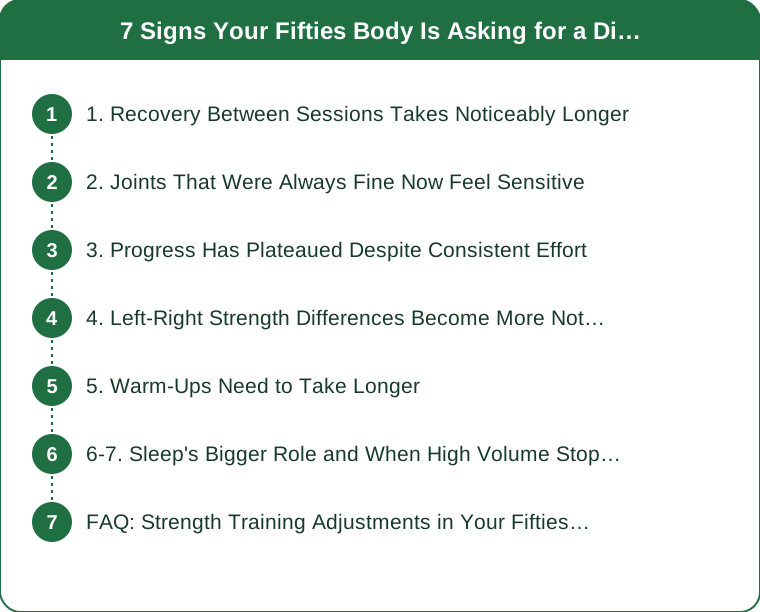
1. Recovery Between Sessions Takes Noticeably Longer
If soreness or fatigue from a session lingers longer than it used to for the same relative effort, this reflects a real, well-documented age-related shift in recovery capacity — the fix is typically adding an extra rest day between similarly intense sessions, not reducing training altogether.
2. Joints That Were Always Fine Now Feel Sensitive
New joint discomfort in movements that were previously never an issue often signals a need for adjusted range of motion, tempo, or load rather than avoiding the movement entirely — many trainers recommend modifying the angle or adding more warm-up volume specifically for that movement pattern first.
3. Progress Has Plateaued Despite Consistent Effort
A plateau that persists despite showing up consistently often means the same program structure that worked for years now needs actual variation — changing rep ranges, exercise selection, or training splits, since the body’s adaptive response to repeated identical stimulus can shift with age.

4. Left-Right Strength Differences Become More Noticeable
Asymmetries that were minor in younger years can become more pronounced, sometimes due to accumulated old injuries becoming more apparent. Adding unilateral (single-side) exercises to address this directly tends to work better than continuing only bilateral movements and hoping it evens out.
5. Warm-Ups Need to Take Longer
Needing a longer, more gradual warm-up before working weight feels ready is a normal shift, not a weakness — joint lubrication and tissue elasticity genuinely take more time to activate, and skipping this adjustment increases injury risk during the actual working sets.
6-7. Sleep’s Bigger Role and When High Volume Stops Working
6. Sleep Quality Affects Training Performance More Directly
Many women in their fifties report a tighter connection between sleep quality and next-day training performance than in earlier decades, which is worth tracking — a rough night’s sleep may call for adjusting session intensity that day rather than pushing through as usual.
7. Very High Training Volume Stops Feeling Productive
If more sets and reps stop translating to more progress, and instead correlate with worse recovery, this often means training volume needs to come down while intensity (weight relative to capacity) can often stay the same or even increase — quality over sheer volume becomes a more effective principle.
FAQ: Strength Training Adjustments in Your Fifties, Answered
Does this mean strength training should get easier in your fifties?
Not necessarily easier — often more strategic, with adjusted recovery, exercise selection, and volume rather than simply lower effort.
Is it too late to start strength training for the first time in your fifties?
Not at all — starting strength training in your fifties still produces meaningful strength, bone density, and metabolic benefits; the same adjustment principles apply from day one.
Should these adjustments be made with a trainer’s guidance?
Working with a knowledgeable trainer, at least initially, can help identify which specific adjustments apply to your situation rather than guessing. This is general information, not medical advice.
TL;DR:
- Longer recovery and new joint sensitivity are normal age-related signals, not stop signs
- A stalled plateau usually means the program needs variation, not more effort
- Left-right imbalances and warm-up needs both call for direct adjustments
- Sleep quality and total training volume both deserve more attention than in earlier decades
These seven signs point to adjusting your approach, not abandoning strength training — the fifties body responds well to strategy, just a different strategy than the thirties body needed.
Keep Reading
This article is for general informational purposes only and is not medical advice. Always consult a qualified health professional for guidance specific to you.