7 Signals Your Body Is Actually Adapting to Strength Training in Your Fifties
Quick Answer: In your fifties, real strength training progress shows up more reliably in daily function, recovery speed, and bone-loading markers than on the scale — signals like easier stair climbing, faster next-day recovery, and improved balance are more meaningful indicators of adaptation than weight change alone.
Strength training in your fifties genuinely works, but the scale is often the least informative place to look for proof of it.

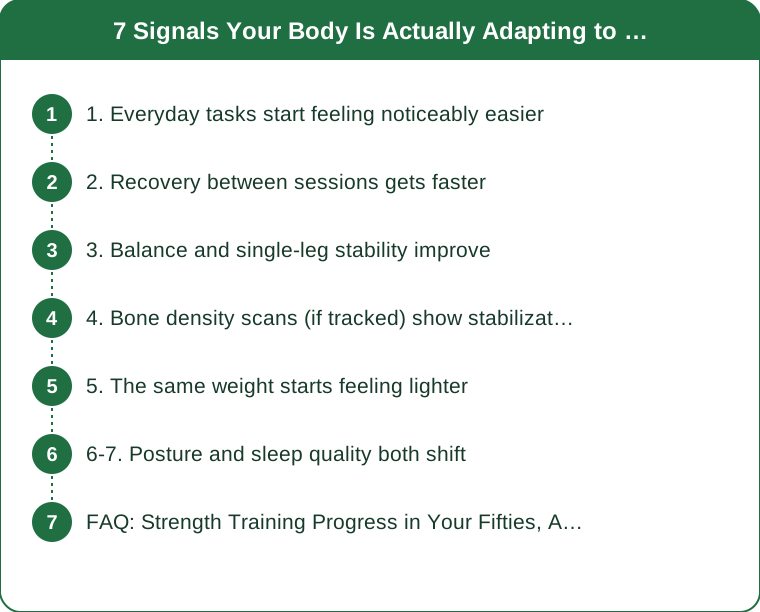
1. Everyday tasks start feeling noticeably easier
Carrying groceries, climbing stairs, or getting up from the floor without using your hands getting measurably easier over a few months is a direct, functional sign of real strength gain — and one of the most meaningful ones, since it reflects the actual purpose most people in their fifties are training for.
2. Recovery between sessions gets faster
Feeling ready to train again in 48 hours instead of needing 4 days reflects genuine improvements in recovery capacity and muscular resilience, and is a commonly overlooked but reliable adaptation marker specific to consistent strength training over time.
3. Balance and single-leg stability improve
Being able to stand on one leg longer, or feeling steadier on uneven ground, reflects real neuromuscular adaptation — this matters particularly in your fifties since balance-related fall risk is a significant and well-documented health concern that strength training measurably improves.

4. Bone density scans (if tracked) show stabilization or improvement
For those getting periodic DEXA scans, stabilized or improved bone density readings are one of the strongest objective signs that resistance training is doing exactly what it’s most valuable for in this age range, since bone density loss otherwise tends to accelerate through the fifties.
5. The same weight starts feeling lighter
Even without adding weight to the bar, the same load requiring less perceived effort over several weeks is a genuine strength and efficiency adaptation, and often precedes being ready to actually increase the load.
6-7. Posture and sleep quality both shift
Posture improves noticeably. Strength training that includes back and core work commonly produces visible postural improvement within a few months, which reflects genuine strengthening of postural muscles that tend to weaken with age and prolonged sitting.
Sleep quality improves on training days. Many people in their fifties report more consistent, higher-quality sleep on days they strength train compared to rest days, which is a well-supported secondary benefit and a useful, easy-to-notice indicator that the training load is appropriately dosed.
FAQ: Strength Training Progress in Your Fifties, Answered
Is it normal for visible muscle change to be slower to appear than in younger years?
Yes — visible hypertrophy is generally slower in your fifties due to natural hormonal changes, which is exactly why the functional and recovery-based signals above are more reliable near-term indicators than visible muscle change alone.
How long does it typically take to notice these adaptation signals?
Many people notice functional signals like easier stair climbing and faster recovery within 6-8 weeks of consistent training, while bone density changes take considerably longer (often 6-12 months) to show up on a scan.
Should someone in their fifties expect the same rate of strength gain as someone in their thirties?
Not necessarily the same rate, but meaningful, real strength gain is well-documented at this age with consistent progressive training — the timeline and some of the visible markers simply look somewhat different.
TL;DR:
- Everyday functional ease is a more meaningful sign of progress than the scale in your fifties
- Faster recovery between sessions reflects genuine adaptation, not just feeling motivated
- Balance and posture improvements carry real fall-prevention and health value at this age
- Bone density stabilization is one of the strongest objective adaptation markers available
The scale was never the right measuring stick here — function, recovery, and stability are.
Keep Reading
This article is for general informational purposes only and is not medical advice. Always consult a qualified health professional for guidance specific to you.