7 Strength Training Myths Holding Women Over 50 Back
Strength training advice for women over 50 is full of outdated caution. These 7 myths are still widely repeated — and believing them costs real muscle and bone density.

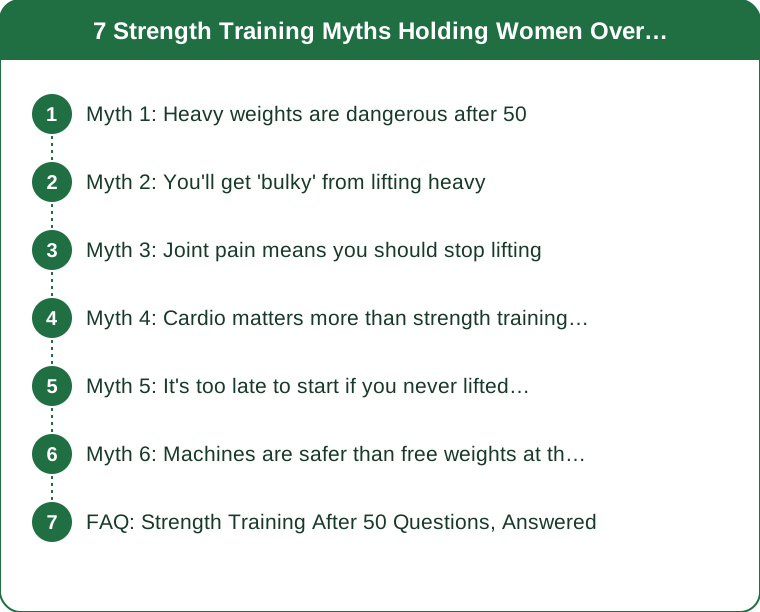
Myth 1: Heavy weights are dangerous after 50
Fact: properly progressed heavy strength training is one of the most protective things a woman over 50 can do for bone density and joint stability — light weights with high reps don’t stimulate the same bone-strengthening response.
Myth 2: You’ll get ‘bulky’ from lifting heavy
Fact: significant muscle bulk requires a training and eating strategy specifically built for it, plus hormonal conditions most women over 50 don’t have. What actually happens is a leaner, more defined look as muscle replaces the fat lost through training.
Myth 3: Joint pain means you should stop lifting
Fact: the right kind of loading, at appropriate range of motion, often reduces joint pain over time by strengthening the muscles that stabilize the joint — though sharp or worsening pain always warrants a professional evaluation first, not just pushing through.

Myth 4: Cardio matters more than strength training for this age group
Fact: after 50, muscle mass naturally declines around 1-2% a year without resistance training — cardio doesn’t offset that loss. Both matter, but strength training is the one most women are under-doing relative to what protects long-term function.
Myth 5: It’s too late to start if you never lifted before
Fact: beginners over 50 often see faster relative strength gains in the first few months than younger lifters, because there’s more room for neurological and muscular adaptation. The body responds to training stimulus at any starting age.
Myth 6: Machines are safer than free weights at this age
Fact: machines can be a reasonable starting point for confidence, but free weights and bodyweight training build the stabilizer strength and balance that actually prevent falls — the real-world risk most women over 50 are training to reduce.
FAQ: Strength Training After 50 Questions, Answered
How many days a week should a woman over 50 strength train?
Most guidance lands on 2-3 full-body sessions weekly with at least one rest day between, which is enough stimulus for most people while allowing adequate recovery.
Is it normal to be sorer for longer after 50?
Somewhat, yes — recovery can take a bit longer, which is a reason for gradual progression, not a reason to avoid heavier lifting altogether.
Should you get medical clearance before starting?
If you have existing joint issues, osteoporosis, or heart conditions, yes — a quick conversation with your doctor first is a reasonable, low-cost precaution. This is general information, not medical advice.
TL;DR:
- Heavy, properly progressed lifting is protective, not dangerous, after 50
- ‘Bulk’ fear is misplaced — the real result is more definition and strength
- Muscle loss accelerates after 50 without resistance training; cardio alone doesn’t offset it
- Free weights build the stabilizer strength that actually prevents falls
The biggest myth of all is that it’s too late — the data says otherwise, and so does every woman who started at 55 and got strong.
Keep Reading
This article is for general informational purposes only and is not medical advice. Always consult a qualified health professional for guidance specific to you.