7 Strength Training Mistakes Women Over Fifty Make Without Realizing It
Quick Answer: The most common mistakes are staying with too-light weights out of caution, skipping proper warm-up specifically for joint mobility, avoiding compound movements in favor of only machines, under-eating protein relative to increased needs, not allowing enough recovery time between sessions, ignoring balance and stability training, and stopping entirely after an unrelated minor injury — each one is fixable and doesn’t require reducing training intensity overall.

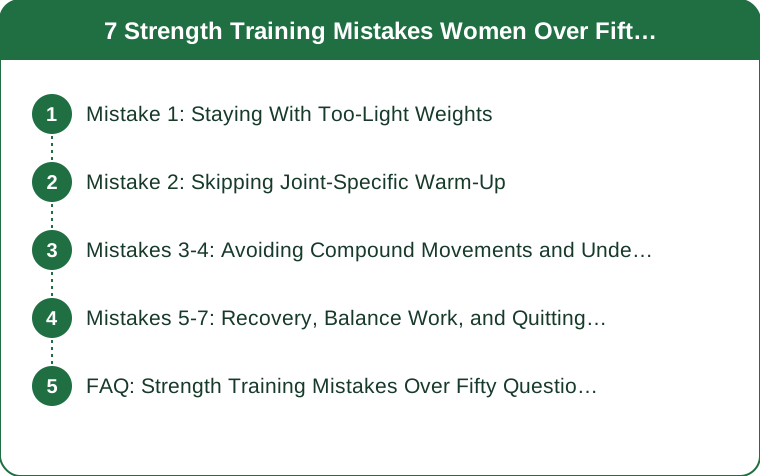
Mistake 1: Staying With Too-Light Weights
A common, well-intentioned caution leads many women over fifty to under-load strength exercises, but building and maintaining muscle mass at this life stage specifically requires progressively challenging resistance — weight that’s genuinely difficult by the last few repetitions, not weight that feels easy throughout.
Mistake 2: Skipping Joint-Specific Warm-Up
Joints tend to need more deliberate mobility preparation with age, and skipping this in favor of jumping straight into working sets increases injury risk in ways that weren’t as significant at a younger age — a few minutes of joint-specific mobility work before loading meaningfully reduces this risk.

Mistakes 3-4: Avoiding Compound Movements and Under-Eating Protein
Mistake 3 — Relying only on machines, avoiding compound free-weight movements: compound movements (squats, deadlifts, presses) build functional strength and bone density more effectively than isolated machine exercises alone, and avoiding them due to unfamiliarity or perceived risk leaves real benefit on the table when done with appropriate form and load. Mistake 4 — Not increasing protein intake to match increased needs: protein requirements for maintaining muscle mass tend to rise with age, and many women don’t adjust intake upward to match this increased need, which can blunt strength training results regardless of how well the training itself is structured.
Mistakes 5-7: Recovery, Balance Work, and Quitting After Minor Injury
Mistake 5 — Not allowing enough recovery between sessions: recovery time between strength sessions targeting the same muscle groups often needs to be somewhat longer with age, and training too frequently without adjustment can blunt progress rather than accelerate it. Mistake 6 — Ignoring balance and stability training: strength training alone doesn’t fully address balance, which becomes increasingly important for fall prevention with age — adding dedicated balance work alongside strength training closes this gap. Mistake 7 — Stopping training entirely after an unrelated minor injury: an injury to one area (like a wrist sprain) doesn’t require abandoning all strength training — modifying around the affected area while continuing to train unaffected muscle groups maintains far more progress than stopping completely.
FAQ: Strength Training Mistakes Over Fifty Questions, Answered
Is it too late to start strength training seriously for the first time after fifty?
No — research consistently shows meaningful strength and muscle gains are achievable starting strength training for the first time well into and beyond your fifties, sixties, and beyond, given appropriate progression and form.
How many strength sessions per week are ideal after fifty?
2-3 sessions per week targeting all major muscle groups is a commonly recommended target, with adequate recovery time between sessions hitting the same muscle groups.
Should form be checked by a professional before increasing weight significantly?
Yes, particularly when returning to or starting strength training after fifty — a session or two with a qualified trainer to check form on key compound movements is a worthwhile investment before progressively increasing load.
TL;DR:
- Progressive, genuinely challenging resistance matters more than caution-driven light weights
- Joint-specific warm-up and adequate recovery time both become more important with age
- Compound movements and adjusted protein intake both meaningfully support results
- A minor unrelated injury doesn’t require stopping all training — modify around it instead
Strength training after fifty works just as well as at any age when these specific, fixable mistakes are addressed.
Keep Reading
This article is for general informational purposes only and is not medical advice. Always consult a qualified health professional for guidance specific to you.