7 Things That Actually Change When You Start Strength Training After Fifty
Quick Answer: Strength training after fifty produces measurable changes in bone density, grip strength, balance, and metabolic markers within 12-16 weeks — the biggest difference from training younger is slower initial recovery, not slower progress.
You’ve heard ‘strength training is good for you after fifty’ a hundred times, in the vaguest possible terms. Here’s what specifically changes, and roughly when.

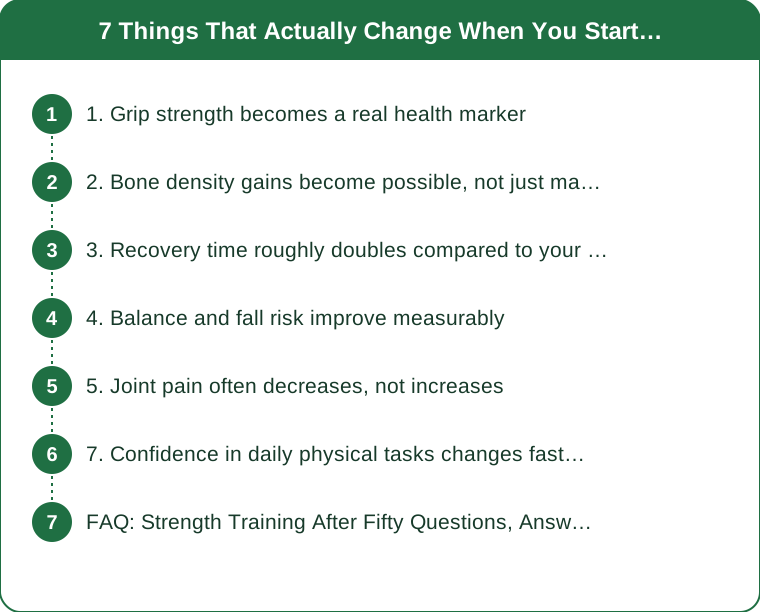
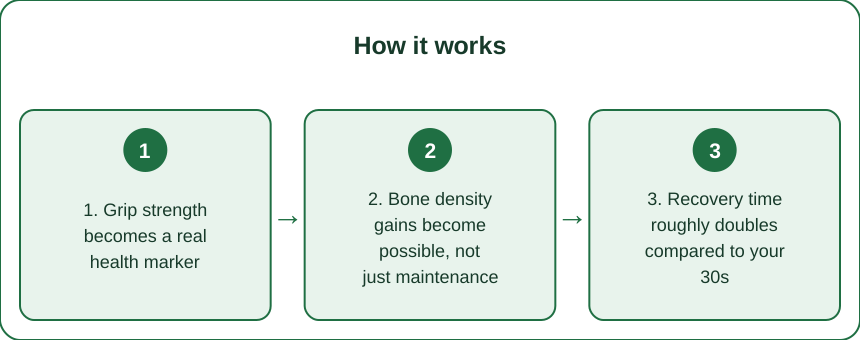
1. Grip strength becomes a real health marker
Grip strength correlates strongly with overall mortality risk in research on adults over 50 — it’s now used as a simple proxy for whole-body strength and even cardiovascular health in some studies. Regular resistance training measurably improves it within 8-12 weeks.
2. Bone density gains become possible, not just maintenance
Contrary to the idea that bone loss after 50 is purely one-directional, load-bearing resistance training (squats, deadlift variations, presses) can measurably slow and in some cases modestly reverse density loss, particularly at the hip and spine — the two most fracture-relevant sites.
3. Recovery time roughly doubles compared to your 30s
This is the change most people aren’t warned about. Muscle protein synthesis and inflammation resolution both slow with age, meaning a session that needed 48 hours of recovery at 30 may need 72-96 hours at 55. Programming 2-3 sessions weekly with real rest days between, rather than daily lifting, respects this shift.

4. Balance and fall risk improve measurably
Strength training that includes single-leg and unstable-surface work reduces fall risk more than balance training alone in adults over 50, according to multiple exercise-science reviews — the strength component appears to matter as much as the balance drills themselves.
5. Joint pain often decreases, not increases
A common fear is that lifting will aggravate joints — but properly loaded, progressive strength training around joints (rather than avoiding movement) frequently reduces osteoarthritis-related pain by strengthening the surrounding musculature that stabilizes the joint.
6. Metabolic markers shift within a few months
Insulin sensitivity and resting metabolic rate both respond to added muscle mass — studies show measurable improvement in blood sugar regulation within 12-16 weeks of consistent resistance training in previously sedentary adults over 50.
7. Confidence in daily physical tasks changes faster than the mirror does
Most people notice functional changes — carrying groceries, getting up off the floor, climbing stairs without pausing — well before visible physique changes. This functional confidence is consistently reported as the most motivating early change.
FAQ: Strength Training After Fifty Questions, Answered
How soon will I see results starting strength training at 50+?
Functional strength and energy improvements often show up in 4-6 weeks; visible and measurable body composition changes typically take 12-16 weeks.
Is it safe to start strength training with an old injury after 50?
Usually yes, with modified movement and often physical therapy guidance first — building strength around an old injury frequently reduces pain rather than aggravating it, but check with a professional if you’re unsure. This is general information, not medical advice.
How many days a week should someone over 50 strength train?
2-3 full-body sessions weekly with rest days between is the typical evidence-based recommendation, allowing for the longer recovery window at this age.
TL;DR:
- Grip strength and bone density both respond measurably to consistent training
- Recovery takes roughly twice as long as in your 30s — program rest accordingly
- Balance, joint pain, and metabolic markers all improve with proper loading
- Functional confidence (stairs, groceries, floor) usually improves before the mirror does
Start at 2-3 sessions weekly, respect the longer recovery window, and the changes compound faster than most people expect.
Keep Reading
This article is for general informational purposes only and is not medical advice. Always consult a qualified health professional for guidance specific to you.