7 Strength Numbers Worth Tracking After Fifty — and 3 Worth Ignoring
Quick Answer: After fifty, the metrics that predict long-term independence and function are different from the ones that measure peak performance. Track grip strength, sit-to-stand speed, single-leg balance time, total weekly working sets, protein intake, sleep consistency, and recovery between hard sessions. Ignore one-rep max chasing, daily scale weight, and total step count as a training metric — none of them tell you what you need to know.
The numbers most training apps put on the front screen were designed to help a 28-year-old add ten pounds to a squat.
After fifty, the question changes from how much can I lift today to how well will I move in twenty years — and that question has its own measurements.

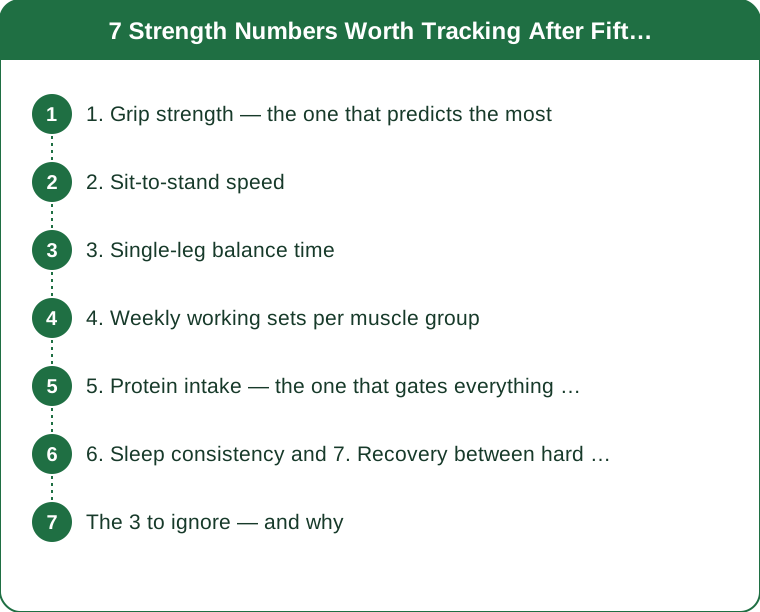
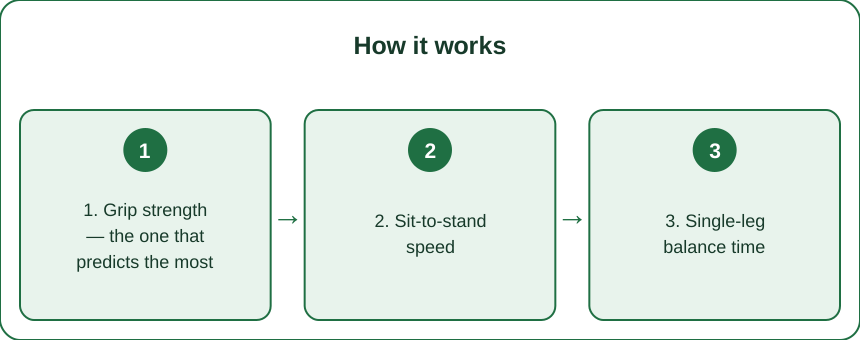
1. Grip strength — the one that predicts the most
Why it matters: grip strength is one of the most studied simple markers in the whole of aging research, and it correlates with overall muscle strength, functional independence, and a range of long-term health outcomes. It is not that squeezing a device makes you healthier — it is that grip is an efficient proxy for total-body strength and neuromuscular health.
How to track it: a hand dynamometer costs very little. Test the same way each time — seated, elbow at 90 degrees, three attempts per hand, record the best.
What to look for: the trend over months, not the number itself. A stable or rising grip through your fifties and sixties is the signal. Population averages exist but individual variation is wide enough that your own baseline is more informative.
How to improve it: carries. Farmer’s carries, suitcase carries, and simply stopping the use of straps on rows and deadlifts. Dead hangs from a bar — accumulating 60 to 90 seconds across a few sets — build it efficiently and improve shoulder health at the same time.
Test monthly. More often than that and you are measuring day-to-day noise.
2. Sit-to-stand speed
Why it matters: rising from a chair without using your hands is the single most functionally relevant movement pattern in daily life after fifty, and the speed at which you can repeat it reflects lower-body power rather than just strength. Power declines faster than strength with age — roughly twice as fast — and it is power that determines whether you catch yourself when you stumble.
How to track it: the standard test is 30 seconds — count how many full stands you complete from a standard dining chair, arms crossed over your chest. Alternatively, time five repetitions.
What to look for: for the 30-second version, most healthy women in their fifties manage somewhere in the mid-teens or higher, and the number to care about is your own trend. A decline of two or three repetitions over a year, with no other explanation, is worth paying attention to.
How to improve it: the movement itself, loaded. Goblet squats to a box, step-ups, and — importantly — fast concentric intent. Stand up quickly, lower slowly. Training power requires trying to move fast, and this is the piece most general strength programs leave out entirely.
Test quarterly.
3. Single-leg balance time
Why it matters: balance is trainable, it declines quietly, and falls are the dominant cause of serious injury in later decades. The ability to stand on one leg for ten seconds has been studied as a marker associated with longer-term outcomes, which sounds absurd until you consider what it requires — vestibular function, proprioception, ankle and hip strength, and neural coordination all at once.
How to track it: eyes open, arms crossed, one leg lifted slightly. Time until you have to put the foot down or grab something. Test both legs, and stand near a counter for safety.
What to look for: a large asymmetry between legs is the most actionable finding, and it usually points to an old injury or a hip strength difference.
How to improve it: direct practice, which works quickly. Thirty seconds per leg while brushing your teeth is genuinely enough to make progress. Progress by closing your eyes — eyes-closed balance is dramatically harder and trains the proprioceptive system directly.
Test monthly.

4. Weekly working sets per muscle group
Why it matters: this is the volume metric that actually drives strength and muscle retention, and it is the one people track least. Not how many workouts, not how many hours — how many hard sets per muscle group per week.
What to aim for: roughly 10 to 20 hard sets per major muscle group per week is the range most of the evidence supports for building and maintaining muscle. Below about 6 sets, maintenance becomes difficult. After fifty this range does not change much, but recovery between those sets often needs to be longer.
How to track it: a tally in a notebook. Legs, back, chest, shoulders, arms. Count only sets taken reasonably close to failure — a warm-up set does not count.
Why it beats tracking workouts: three sessions a week that each hit legs with two sets is six sets, which is maintenance at best. Two sessions a week with five sets each is ten, which is a growth stimulus. The number of workouts told you nothing.
5. Protein intake — the one that gates everything else
Why it matters: muscle protein synthesis becomes less responsive with age, a phenomenon called anabolic resistance. The practical consequence is that older adults need more protein per meal to trigger the same response, and training without adequate protein produces disappointing results regardless of how good the program is.
What to aim for: commonly cited targets for active adults over fifty are in the range of 1.2 to 1.6g per kilogram of body weight per day, distributed across meals rather than concentrated in one. Per-meal distribution matters more after fifty than before it — roughly 25 to 35g per meal is the usual guidance.
How to track it: three days of honest logging, twice a year. Continuous tracking is unnecessary and for many people counterproductive.
The common finding: breakfast is almost always the shortfall. Most people hit reasonable protein at dinner and fall far short in the morning, which wastes the first third of the day.
6. Sleep consistency and 7. Recovery between hard sessions
Sleep consistency — why it matters: total sleep duration gets all the attention, but consistency of timing is at least as important and it is more achievable. Going to bed and rising within about an hour of the same time daily supports the hormonal rhythms that govern recovery and appetite.
How to track it: bedtime and wake time in a notebook, or the consistency metric on any wearable. What you are looking for is the spread, not the average — a week of 7-hour nights at wildly different times is worse than a week of consistent 6.5-hour nights.
Recovery between hard sessions — why it matters: this is the metric that changes most with age. Connective tissue adapts more slowly than muscle, and tendon recovery in particular lengthens. The most common training error after fifty is not training too little, it is repeating hard sessions before recovery is complete.
How to track it: a simple 1-to-10 readiness note before each session, plus how you felt 48 hours after the last hard one. Persistent soreness beyond 72 hours, or strength that is down two sessions in a row, means the interval is too short.
What to do with it: extend the gap between hard sessions for the same muscle group before reducing the work within them. Most people over fifty do better on a slightly longer cycle with full-effort sessions than on frequent moderate ones.
The 3 to ignore — and why
Ignore: chasing a one-rep max. Testing true maximum loads carries meaningful injury risk, particularly for connective tissue that adapts slowly, and it tells you very little that a well-tracked working set does not. Track the weight you can handle for 6 to 10 clean reps instead — it is safer, less variable day to day, and more relevant to how you actually train.
Ignore: daily scale weight. Day-to-day weight is dominated by water, sodium, glycogen, and digestion. Worse, strength training tends to keep the scale flat while body composition improves, which makes daily weighing actively misleading during exactly the period it matters most. If you want a body composition signal, use how clothes fit and a monthly waist measurement.
Ignore: total step count as a training metric. Steps are a fine general activity measure and they are not a strength or power measure at all. Hitting 12,000 steps a day does nothing to preserve the fast-twitch muscle fibers that decline fastest after fifty. Walking is genuinely good for you, and it is not a substitute for loading — plenty of very active walkers lose significant strength through their sixties.
The pattern behind all three: they measure things that are easy to measure rather than things that predict how you will move in twenty years. The seven above are harder to collect and worth far more.
TL;DR: After fifty, track function and recovery — not peak performance.
- Grip strength monthly, with a cheap dynamometer. The best-studied simple proxy for overall strength.
- Sit-to-stand in 30 seconds, quarterly. Measures power, which declines twice as fast as strength.
- Single-leg balance, monthly, both legs. Asymmetry is the actionable finding.
- Weekly hard sets per muscle group — aim for 10 to 20. This beats counting workouts.
- Protein, 1.2–1.6g/kg spread across meals. Breakfast is almost always the gap.
- Sleep consistency and recovery interval — repeating hard sessions too soon is the most common error after fifty.
- Skip one-rep max testing, daily weigh-ins, and step counts as training metrics.
Pick two from the list and take a baseline this week. A number you measured yourself in August is worth more than any population average.
Keep Reading
This article is for general informational purposes only and is not medical advice. Always consult a qualified health professional for guidance specific to you.