7 Signs Your Warm-Up Needs to Change After Fifty
Quick Answer: After fifty, a warm-up needs to be longer, more joint-specific and more gradual - typically 12 to 15 minutes rather than 5, with dedicated work for the shoulders, hips and ankles and more warm-up sets before the working set. The signs that yours is inadequate include feeling better on set three than set one, joint noise that fades with movement, and needing the first exercise of every session to be an accidental warm-up.
None of this means training less. It means the front end of the session gets a larger share, and the rest of the session gets better.

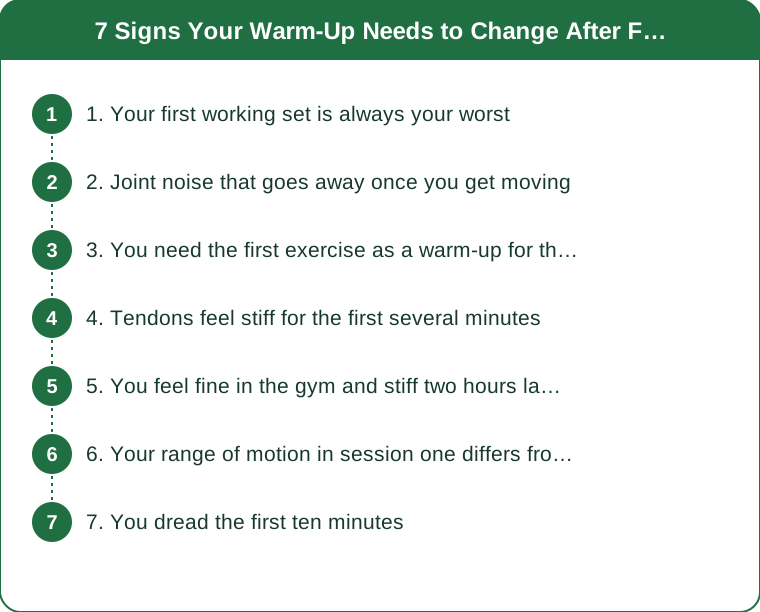
1. Your first working set is always your worst
If set three consistently feels stronger and smoother than set one, your warm-up ended before your body was ready.
What is happening. Muscle temperature, joint fluid distribution and neuromuscular activation all rise progressively. At 30, five minutes gets you most of the way there. Later, the curve is slower - the same preparation leaves you starting the first working set mid-warm-up.
What that costs you. The first set is where technique is least grooved and load is fully applied, which is a poor combination. It is also a wasted set from a training standpoint, since it is performed below your actual capacity.
The fix. Add two to three more ramp-up sets before the working weight. Not to failure, not close - roughly 40, 60 and 80 percent of the working load for a few reps each.
The tell that it worked: set one and set three feel the same. That is the target, and most people have never experienced it because they have never warmed up enough to.
2. Joint noise that goes away once you get moving
Clicking or crunching in the knees or shoulders at the start of a session that disappears after ten minutes is extremely common and generally not concerning on its own.
What it indicates. Joint surfaces are less well lubricated when cold. Synovial fluid becomes less viscous and distributes better with movement, so noise that resolves with warming is usually a lubrication signal rather than a damage signal.
Why it matters for the warm-up. It is a direct readout of how prepared that joint is. If your knees are noisy through your first two sets of squats, those sets happened before the joint was ready.
What to do. Add joint-specific preparation - controlled bodyweight movement through the full range for the joints you are about to load. Ten slow bodyweight squats, ten arm circles in both directions, ankle rocks against a wall.
When it is not benign. Noise accompanied by pain, swelling, catching or locking is a different presentation and should be assessed by a professional.
This is general information, not medical advice.
3. You need the first exercise as a warm-up for the second
A common pattern: bench press feels rough, and by the time you get to the overhead work, everything is fine.
What it means. The general warm-up did not prepare the specific joints and tissues that the first exercise demanded, so the exercise itself did the preparing.
Why that is a problem. You are using a loaded compound movement as a warm-up, which is exactly the movement least suited to that role - it is where load is highest and control matters most.
The fix is movement-specific preparation. Before pressing, do band pull-aparts and shoulder external rotations. Before squatting, do bodyweight squats and hip openers. Before deadlifting, do hip hinges with a dowel.
Two to three minutes each, and it is targeted rather than general. Five minutes on a bike raises core temperature and does essentially nothing for shoulder external rotation.
A useful test: if you would rather do your second exercise first, your warm-up is not matching your first exercise.

4. Tendons feel stiff for the first several minutes
Different from muscle stiffness, and it is the change people notice most clearly with age.
What is happening. Tendon properties change over time - tendons become somewhat stiffer and less elastic, and they respond to loading more slowly than muscle does. Tendon tissue also has considerably lower blood supply than muscle, so it warms and adapts more slowly.
The training implication. Muscle can be ready before tendon is. That mismatch matters most in explosive or heavily loaded movements, where the tendon takes a large share of the load.
What to do. Add slow, controlled loaded repetitions early in the session - a set of slow tempo bodyweight or light-load repetitions through the full range, taking three seconds down and three up. This loads the tendon deliberately at low intensity.
Give it more time, specifically. Tendon-heavy movements like heavy hinging, jumping or sprinting deserve the longest ramp-up of anything in your session.
And be patient across weeks. Tendon adaptation to training happens on a slower timeline than muscle adaptation, which is why the progression that feels too slow is usually the right one.
5. You feel fine in the gym and stiff two hours later
The session felt smooth and the afternoon is a different story.
What that suggests. A warm-up that raised temperature enough for the session to feel good, but that did not prepare the tissue for the actual load - so the tissue took more strain than it was ready for and the response shows up later.
It can also be a cool-down issue. Going from a heavy session directly to sitting in a car for 40 minutes leaves everything in a shortened position while it is still inflamed.
What to do on the front end. Longer ramp-up sets, particularly on the first compound of the day.
What to do on the back end. Five minutes of easy movement after the last set, and avoid sitting still immediately after. Walking to the car does not count as a cool-down; walking for five minutes does.
Track the pattern for two weeks. If the delayed stiffness correlates with sessions where you rushed the warm-up, you have your answer without needing to guess.
6. Your range of motion in session one differs from session three
Warming up should not be the thing that gives you your depth back every single time.
What is happening. If you can only reach full squat depth or full overhead position after several sets, you are gaining range through warming rather than possessing it. That is fine as a temporary state and it means your available range at the start of the session is limited.
Why it matters. The first set gets performed in a restricted range with full load, which puts the joint in its least favorable position at its highest demand.
What to do. Add dedicated mobility work for the limiting joint before loading - typically ankles for squat depth, thoracic spine and shoulders for overhead positions, and hips for hinging.
Dynamic, not static, before lifting. Static stretching immediately before strength work can temporarily reduce force production, whereas dynamic movement through the range prepares without that cost. Keep the long static holds for after the session or a separate time of day.
Two minutes on the limiting joint frequently unlocks more than ten minutes of general work.
7. You dread the first ten minutes
The least technical sign and possibly the most reliable.
What it means. If starting the session consistently feels bad, the start of the session is too abrupt. People respond by pushing through it, which reinforces the association.
Why it matters beyond comfort. Adherence is the variable that determines training outcomes over years, and the first ten minutes is where most abandoned sessions are abandoned. A warm-up that feels good is not indulgent - it is what makes the session happen at all.
What to do. Start easier than feels necessary. Five minutes of genuinely easy movement - walking, easy cycling, gentle full-range bodyweight work - before anything that requires effort or attention.
Then progress gradually. General warming, then joint-specific preparation, then movement-specific ramp-up sets. Roughly 12 to 15 minutes total, which sounds like a lot until you compare it to the sessions you have skipped because the first ten minutes felt awful.
The return on this is unusually high. A longer warm-up costs you ten minutes and typically buys better first sets, less next-day stiffness, and a session you are more willing to start next time.
This is general information, not medical advice. Persistent joint pain should be assessed by a healthcare professional.
TL;DR:
- Seven signs your warm-up is too short: a weak first set, joint noise, using exercise one to prepare for exercise two, slow tendon readiness, delayed stiffness, range that only appears by set three, and dreading the start.
- Target roughly 12 to 15 minutes: general warming, then joint-specific work, then two to three ramp-up sets per compound movement.
- Keep static stretching out of the pre-lift warm-up and use dynamic movement through the full range instead.
- Tendons warm and adapt more slowly than muscle, so tendon-heavy movements deserve the longest ramp-up.
- The goal is set one feeling like set three - most people have never experienced that and assume it is not available.
Nothing here means training less or lifting lighter. It means moving ten minutes of the session to the front, where it improves everything that comes after it.
Keep Reading
This article is for general informational purposes only and is not medical advice. Always consult a qualified health professional for guidance specific to you.