7 Signs Your Recovery After Fifty Is Actually Fine
Quick Answer: After fifty, people start attributing every training sensation to age, and most of it is just normal training. Soreness that peaks at 48 hours, needing a longer warm-up, feeling strong on day one of a block and flat on day four, and stiffness that clears within twenty minutes of moving are all signs of a system working correctly. The genuinely concerning signs are different, specific, and there are only three of them.
There is a particular kind of vigilance that starts somewhere around fifty. Every ache gets examined. Every flat session becomes evidence.
Some things do change with age and are worth knowing about. But a great deal of what gets labelled as decline is exactly what recovery is supposed to feel like at any age, and mistaking it for decline leads people to train less than they should.

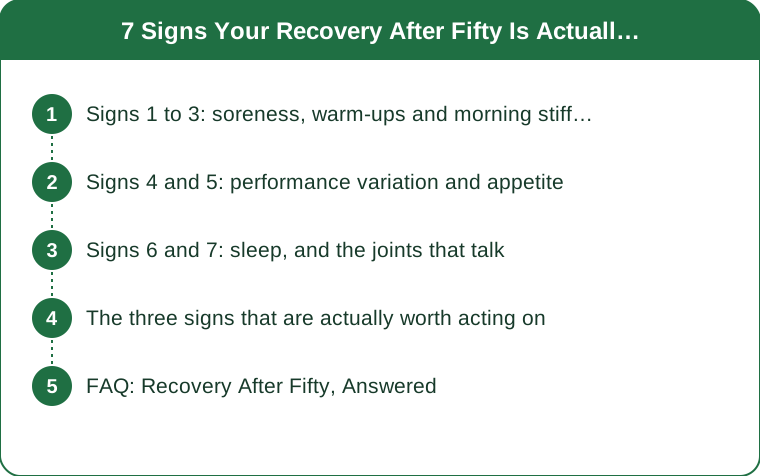
Signs 1 to 3: soreness, warm-ups and morning stiffness
1. Soreness peaks around 24 to 48 hours and then fades
Delayed onset muscle soreness following the familiar curve — building overnight, worst on day two, gone by day four — is the normal response to unaccustomed work, and it does not change fundamentally with age. Research comparing older and younger adults finds broadly similar soreness patterns.
If your soreness follows this curve, your muscles are repairing on schedule. It is not evidence of anything.
2. You need a longer warm-up than you used to
Completely normal and not a decline signal in any meaningful sense. Synovial fluid viscosity, tendon compliance and tissue temperature all take longer to reach working condition with age. A 10 to 15 minute warm-up where you once did five is an adjustment, not a symptom.
The useful marker: once warmed up, do you feel normal? If the first set is rough and the third set feels good, the system is working. If you never feel warmed up, that is a different conversation.
3. Morning stiffness that clears within twenty minutes
Stiffness on waking that resolves with movement is normal at every age and becomes more noticeable with age and with cooler weather — which is worth remembering right now, since morning stiffness reliably increases as temperatures drop.
The threshold that matters: stiffness lasting more than an hour, particularly with joint swelling, is worth mentioning to a doctor, since prolonged morning stiffness is one of the recognised markers of inflammatory arthritis. Under twenty minutes and clearing with movement is the ordinary version.
Signs 4 and 5: performance variation and appetite
4. Strength varies day to day by ten percent or so
Daily performance fluctuation is normal at every age. Sleep, hydration, stress, time of day, food timing and cumulative fatigue all move working strength around, and a 5 to 10 percent swing between sessions is completely ordinary.
What people over fifty do differently is interpret it. A younger lifter has a bad session and thinks bad night’s sleep. An older lifter has the same session and thinks this is starting. The data is identical; the story is not.
The pattern that means something is a trend, not a day. Look at your working weights across four to six weeks. Flat or rising is fine. A single low session is noise.
5. You feel strong early in a block and flat by the end
This is fatigue accumulating exactly as intended. Progressive overload works by accumulating fatigue and then removing it, which is why programmes include deload weeks.
Feeling flat in week four of a hard block is the system telling you the block is working, and it is followed by a supercompensation once load drops. What changes with age is mainly the rate — recovery between hard sessions may take somewhat longer, and deloads may be needed slightly more often, perhaps every fourth week rather than every sixth.
That is a programming variable, not a decline. Anyone can adjust it.

Signs 6 and 7: sleep, and the joints that talk
6. You sleep hard the night after a hard session
Deeper sleep following heavy training is a good sign — it indicates a real training stimulus and an active recovery response. Slow-wave sleep is where most growth hormone release occurs, and a session that drives you into it earlier is doing its job.
The inverse is the signal worth watching: if hard sessions are consistently followed by poor sleep, restlessness or an elevated resting heart rate overnight, that suggests the stress is exceeding what you are recovering from. That pattern is worth acting on regardless of age.
7. Joints that click, creak or pop without pain
Painless joint noise — crepitus — is extremely common, increases with age, and has repeatedly been shown to have poor correlation with joint damage. Knees that announce every squat and shoulders that click on overhead work are, absent pain and swelling, generally not telling you anything.
People frequently reduce their training because of noise alone, which is unfortunate, because loading a joint through a full range is among the better things for joint health.
The distinction that matters: noise with pain, noise with swelling, or a joint that catches, locks or gives way. Those warrant assessment. Noise alone, consistently, without pain, generally does not.
The three signs that are actually worth acting on
Short list, deliberately, because the point of the seven above is that most things are fine and these are the ones that are not.
1. Soreness or fatigue that lasts beyond four or five days. Normal DOMS resolves within about 72 hours. Soreness that persists for a week, or fatigue that does not lift with a rest day, suggests the load exceeded recovery capacity or something else is going on. The first response is a deload, not a push-through. If a deload does not fix it, get it looked at.
2. Sharp, localised, specific pain — particularly in a tendon. Tendon tissue changes with age: it becomes stiffer, its blood supply is limited, and it adapts more slowly than muscle. This is one of the genuine age-related differences and it matters. The pattern to watch for is pain at a specific point in a tendon that is worse at the start of activity, eases as you warm up, and returns worse afterwards. That is a classic tendinopathy presentation and it responds well to early management and badly to being ignored for six months.
3. Progressive decline over months despite consistent training. Not a bad week. A steady, sustained drop across three months or more while training consistently and eating adequately is worth investigating — thyroid function, iron, vitamin D, medication effects and sleep disorders are all checkable and all common.
The recovery factors that genuinely change with age and are worth attention:
Protein. Older muscle shows anabolic resistance — it needs a larger protein dose per meal to trigger the same synthesis response. Roughly 30 to 40g per meal rather than 20, spread across the day, is the practical adjustment.
Sleep. Sleep architecture changes with age, with less slow-wave sleep. This makes sleep quality more important rather than less, and it is the highest-value recovery lever available.
Deload frequency. Slightly more often. That is the whole adjustment.
This is general information, not medical advice.
FAQ: Recovery After Fifty, Answered
How long should recovery between hard sessions be?
For the same muscle group trained hard, 48 to 72 hours works for most people over fifty, versus 48 for most younger lifters. This is a modest difference and easily accommodated with an upper/lower or push/pull split.
Is it too late to start strength training?
No, and the research on this is unusually clear. Meaningful strength and muscle gains have been demonstrated in people starting in their seventies and eighties. The rate of gain is somewhat slower; the direction is the same.
Should I train through soreness?
Generally yes for mild to moderate soreness — light activity often reduces it. Skip or modify if soreness is severe enough to change your movement pattern, since altered mechanics under load is how people get hurt.
Do I need more rest days than I used to?
Probably one more per fortnight, not per week. The bigger adjustment is usually deload frequency rather than weekly rest days.
Why am I stiffer now that the weather has turned?
Cooler ambient temperature genuinely increases tissue stiffness and slows the warm-up. Extend the warm-up by five minutes and add a layer for the first part of the session. It is a temperature effect, not a new problem.
How do I tell overtraining from getting older?
By testing it. Take a genuine deload week — half the volume, reduced intensity — and see what happens. If you come back stronger, it was fatigue. If nothing changes after two weeks of proper recovery, it is worth a conversation with a doctor.
TL;DR:
- Soreness peaking at 48 hours, longer warm-ups, short morning stiffness, day-to-day variation, end-of-block flatness, hard sleep and painless joint noise are all normal.
- The three worth acting on: soreness beyond four or five days, sharp localised tendon pain, and a decline sustained over three months.
- Real age-related adjustments: 30 to 40g protein per meal, better sleep, and deloading every fourth week.
- Judge trends across four to six weeks, never single sessions.
Most of what gets read as decline after fifty is training working as designed. Knowing which three things are actually signals means you can stop scrutinising the other seven.
Keep Reading
This article is for general informational purposes only and is not medical advice. Always consult a qualified health professional for guidance specific to you.