7 Signs Your Deload Week After Fifty Is Too Short
Quick Answer: After fifty, connective tissue recovers on a longer timeline than muscle does - typically 10 to 14 days rather than 7 for tendons and joints under heavy load. A standard one-week deload resolves muscular fatigue while leaving tendon fatigue in place, which is why you can return feeling fresh and still move worse. The seven signs below distinguish an incomplete deload from ordinary detraining, and the fix is usually longer and lighter, not more frequent.
You followed the program. You deloaded. You came back on Monday and the bar felt heavier than it did the week before you rested, and nobody warned you that was possible.

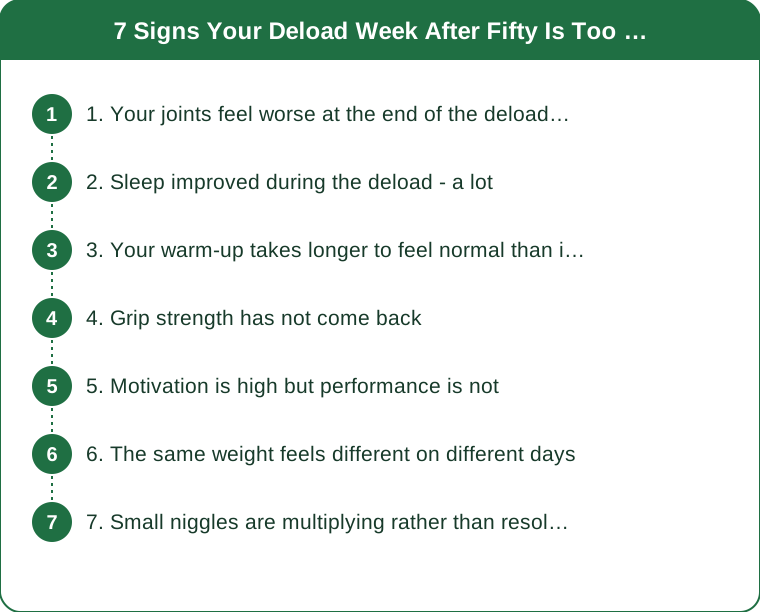
1. Your joints feel worse at the end of the deload than the start
This is the clearest single signal, and it is counterintuitive enough that most people dismiss it.
Muscle soreness resolves in 48 to 72 hours. Tendon and joint irritation takes considerably longer, and after fifty the difference widens.
Connective tissue has less blood supply than muscle. Tendons and ligaments are relatively avascular, and repair is correspondingly slower - which is true at every age and more pronounced with each decade.
Which means a 7-day deload catches muscle and misses tendon. You feel recovered because the tissue that reports soreness has recovered. The tissue that reports pain later has not.
The pattern to watch for: joints that ache more on day five of a deload than on day one usually mean the irritation was still accumulating when you reduced load, and the reduction was not enough or not long enough.
What to do: extend to 10 to 14 days, keep moving at low intensity, and reintroduce load at roughly 60% rather than 80%.
2. Sleep improved during the deload - a lot
A large sleep improvement during a rest week means the previous block was costing you sleep, which is a systemic fatigue signal rather than a local one.
Heavy training raises evening sympathetic activity. In an accumulated-fatigue state, this shows up as difficulty falling asleep, more waking, and lighter sleep overall.
Noticeably better sleep after three or four easy days is diagnostic. It says the nervous system was under more load than you had credited. One week is rarely enough to fully unwind that, particularly when hormonal changes are already affecting sleep architecture.
Sleep is also where recovery happens. Growth hormone release, tissue repair, and consolidation all occur during deep sleep - so a training block that degrades sleep degrades recovery at the same time, and the deficit compounds.
What to do: if sleep clearly improves, treat that as evidence to extend the deload rather than proof it worked. Return when sleep has been good for four or five consecutive nights.
3. Your warm-up takes longer to feel normal than it used to
Warm-up duration is an underrated readiness signal, and it is one you already measure without realizing.
A well-recovered body warms up in roughly ten minutes. If you are still finding range and comfort at twenty, tissue is not ready.
Stiffness that fades slowly indicates lingering inflammation. The classic pattern is stiffness on waking that takes longer than usual to resolve - a common signal after fifty and a reliable one.
Compare against your own baseline, not anyone else’s. The number that matters is how long your warm-up took three months ago versus now.
What to do: keep low-intensity movement daily during the deload. Complete rest is worse than easy movement for connective tissue, because circulation is what delivers repair materials.

4. Grip strength has not come back
Grip is a simple, honest proxy for systemic recovery, and it is easy to check.
Grip strength drops with accumulated fatigue and returns as you recover, which makes it a useful daily readout requiring no equipment beyond something to hold.
It reflects nervous system state, not just forearm muscle. Reduced central drive shows in grip before it shows in the lifts you actually care about.
Test it the same way each morning. A hand dynamometer is ideal; a consistent hang or a heavy carry works as a rough substitute. Down 10% or more at the end of a deload means the deload is not done.
What to do: wait for grip to return to baseline before restarting heavy work. It is a more reliable green light than how motivated you feel.
5. Motivation is high but performance is not
This combination is specific and worth recognizing, because it is the one that leads people back too early.
Psychological freshness recovers faster than physical readiness. A week away restores enthusiasm quickly - and enthusiasm is what gets people back under a heavy bar before their tendons agree.
Feeling good is not the same as being recovered. The gap between them widens with age, which is uncomfortable but useful to know.
Test with a submaximal set instead of a heavy one. A set at 70% that feels heavy tells you what you need to know without costing you anything. A heavy single that feels heavy has already cost you three days.
What to do: use an objective check - bar speed, grip, morning resting heart rate - rather than motivation, to decide when to resume.
6. The same weight feels different on different days
Day-to-day variability in perceived load is a fatigue signature, and it increases when recovery is incomplete.
A recovered system produces consistent output. The same weight feels roughly the same from session to session, within a normal range.
An under-recovered system is erratic. Tuesday’s set flies up and Thursday’s grinds, with no change in sleep, food, or stress that explains it.
This gets more pronounced after fifty as hormonal fluctuation, sleep quality, and recovery capacity all become more variable.
What to do: if variability is high, extend the deload and then return with autoregulation - choose the day’s load based on how the warm-up sets move, rather than what the program says.
7. Small niggles are multiplying rather than resolving
One sore spot is normal. Three at once is a systemic message.
Multiple simultaneous minor complaints indicate global rather than local fatigue. A shoulder, a knee, and a wrist all mildly unhappy is not three separate injuries - it is one recovery deficit expressing itself in the three places you load hardest.
Tendon issues after fifty resolve slowly and recur easily. Returning to load before they settle is the most common route to a problem that lasts months rather than weeks.
What to do: when niggles are multiplying, take two weeks at genuinely low intensity rather than one week at moderate. Keep training - reduce load, keep frequency, keep range of motion. The muscle you lose in two easy weeks is trivially regained; the tendon problem you avoid is not.
How much strength do I actually lose in a two-week deload?
Very little. Measurable strength loss generally begins after two to three weeks of complete inactivity, and a low-intensity deload preserves far more than complete rest does. Most people return stronger.
Should deloads be more frequent after fifty, or longer?
Longer, in most cases. Every four to six weeks is a reasonable frequency at any age; what changes after fifty is that the deload itself needs 10 to 14 days rather than 7.
Is it still a deload if I keep training?
Yes - and it is the better version. Reduce intensity to around 60% and volume by roughly half, keep the same schedule and movements. Circulation and movement pattern are what you are preserving. This is general information, not medical advice; persistent joint pain deserves a professional assessment.
TL;DR:
- Muscle recovers in days; tendon and joint recovery after fifty runs 10 to 14 days, which a standard one-week deload misses.
- Watch for joints worsening across the deload, big sleep improvements, longer warm-ups, and grip strength still down 10%.
- Motivation returns before readiness does - test with a submaximal set, not a heavy one.
- Keep moving at low intensity: complete rest is worse than easy movement for connective tissue.
The hardest part of this is that the correct response to feeling under-recovered is to do less for longer, which feels like falling behind. It is not - two easy weeks costs almost no strength, and the tendon problem it prevents would have cost you a season. Extending the deload is the higher-return decision almost every time.
Keep Reading
This article is for general informational purposes only and is not medical advice. Always consult a qualified health professional for guidance specific to you.