7 Recovery Habits That Matter More After Fifty Than the Training
Quick Answer: After fifty, the limiting factor in strength training shifts from what you can do in a session to what you can recover from between sessions. The seven habits that matter most are protein distribution across the day, sleep consistency, deliberate spacing of heavy sessions, tendon-aware progression, a real warm-up, managing total life load, and tracking recovery rather than just training. Most stalled progress after fifty is a recovery problem wearing a programming disguise.
The programme is not usually the problem.
The seventy-two hours around the programme are.
Seven habits, ordered by how much difference they actually make.
This is general information, not medical advice.

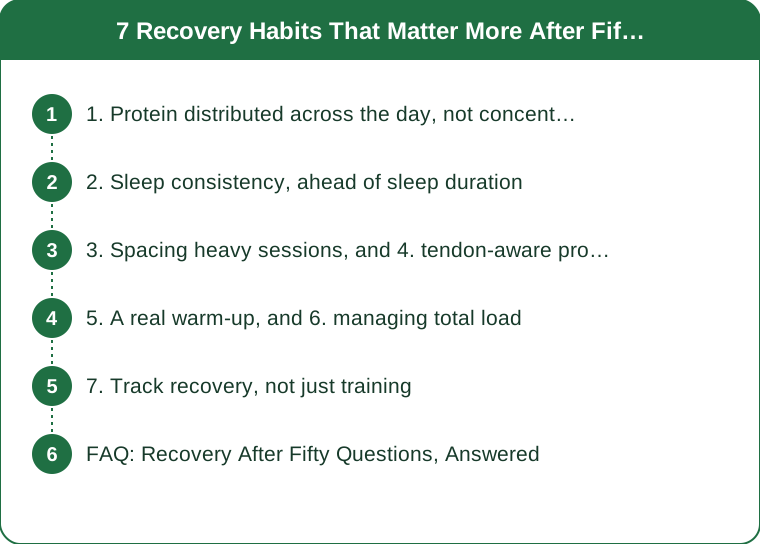
1. Protein distributed across the day, not concentrated at dinner
The distribution matters more after fifty than it did before.
Muscle protein synthesis becomes less responsive to a given dose of protein with age - often described as anabolic resistance. The practical consequence is that the amount needed per meal to trigger a full response goes up.
Which means the common pattern - light breakfast, moderate lunch, large protein dinner - leaves two of three meals below the threshold.
What tends to work:
- Aiming for a meaningful protein serving at each of three meals rather than concentrating it
- Roughly 25-40g per meal as a working target for most people, adjusted for body size
- Paying particular attention to breakfast, which is almost always the lowest-protein meal of the day
- A serving in the hours after training, which is easier to hit if the meal pattern already supports it
Total daily intake matters too, and higher than general guidelines for people doing resistance training after fifty. Around 1.2-1.6g per kg of body weight is a commonly cited range for older adults training regularly, versus the general population recommendation which is considerably lower.
Why this is first on the list: it is the habit with the largest effect that requires no additional time. It is a rearrangement of food you are already eating, and it addresses the specific physiological change that makes training after fifty different.
Anyone with kidney disease should discuss protein targets with their doctor, as the general advice does not apply.
2. Sleep consistency, ahead of sleep duration
The timing of sleep is more actionable than the amount for most people.
Sleep is when the majority of recovery processes occur, and both quality and continuity of sleep tend to change with age - more fragmentation, less deep sleep, earlier timing.
Consistency is the lever with the best return. A regular sleep and wake schedule supports circadian stability, which improves sleep quality independently of duration. It is also easier to change than total duration, which is often constrained by things you do not control.
What makes the largest practical difference:
- Same wake time every day, including weekends, within about an hour
- Morning light exposure within an hour of waking, which is the strongest available anchor for sleep timing
- Keeping the bedroom genuinely cool, since thermoregulation changes with age and heat is a common cause of fragmented sleep
- Caffeine cut-off around eight hours before bed, which is earlier than most people assume given a five to six hour half-life
On training and sleep: hard evening sessions can delay sleep onset for some people, and after fifty this effect tends to be more pronounced. Moving the hardest session earlier is worth testing if sleep is poor on training days.
And a flag worth raising: loud snoring, witnessed breathing pauses or persistent daytime sleepiness warrant a conversation with a doctor. Sleep apnoea becomes more common with age and it undermines every other recovery habit on this list.
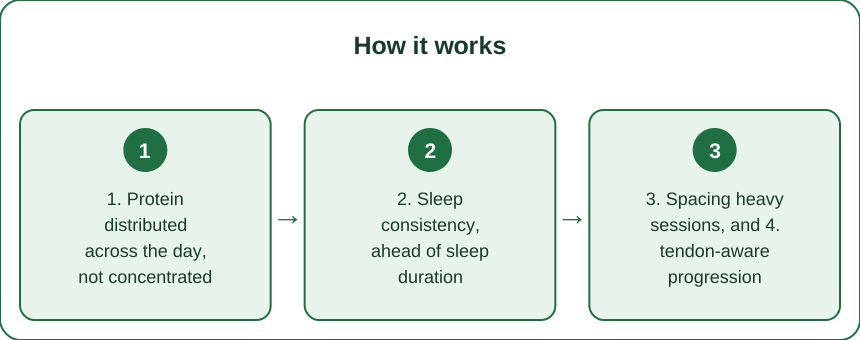
3. Spacing heavy sessions, and 4. tendon-aware progression
Two related changes that address the same underlying shift.
**### 3. Spacing
Recovery from heavy resistance training takes longer after fifty, and the common error is keeping the frequency that worked at forty. Three heavy sessions a week with 48 hours between them can become three heavy sessions with insufficient recovery, producing accumulated fatigue rather than adaptation.
What works better:
- Two genuinely heavy sessions per week with a lighter one between, rather than three heavy
- 72 hours between heavy sessions targeting the same muscle groups, rather than 48
- Alternating heavy and moderate weeks rather than progressing every single week
The signal that spacing is wrong: performance declining across weeks despite consistent training, and soreness that has not cleared by the next session.
### 4. Tendon-aware progression
Tendons adapt more slowly than muscle, and the gap widens with age. Tendon tissue has lower blood supply and slower turnover than muscle, which means the strength you can express can outrun the tissue’s ability to handle it.
This is the mechanism behind most of the frustrating overuse injuries after fifty. The muscle was ready and the tendon was not.
What to do about it:
- Progress load more slowly than you feel capable of - the constraint is not how it feels in the session
- Include slow eccentric work, which is well supported for tendon health
- Take niggles seriously early. Tendon problems caught early resolve far faster than established ones
- Be particularly cautious returning after a break, when muscle recovers faster than tendon and the mismatch is largest

5. A real warm-up, and 6. managing total load
The two habits most often skipped, for different reasons.
### 5. The warm-up
Warm-up requirements increase with age, and the ten-minute version that felt excessive at thirty is roughly right at fifty-five.
What a useful warm-up actually contains:
- Five minutes of general movement to raise tissue temperature
- Mobility work for the joints the session will load, rather than generic stretching
- Progressive ramp-up sets - more of them than younger lifters need, with smaller jumps
- Extra time in cold weather, which is a real and often ignored factor in autumn and winter
The first working set should not be the first hard effort. That is the most common warm-up error and the one most associated with tweaks.
### 6. Total load, not training load
Recovery capacity is shared across everything, not allocated to training. Work stress, caring responsibilities, poor sleep, illness and life disruption all draw on the same capacity.
Which means a training programme that works in a calm month can be too much in a difficult one, and the honest response is to reduce training rather than to conclude you have lost fitness.
Practical version:
- Plan deliberately lighter weeks during known high-stress periods rather than discovering it afterwards
- Treat a bad week of sleep as a reason to reduce training volume, not to push harder
- Accept that maintenance is a legitimate goal during demanding periods - maintaining strength requires substantially less volume than building it
7. Track recovery, not just training
The habit that makes the other six adjustable.
Most people track sets, reps and weight and nothing about recovery, which means the recovery side is managed by feel and by hindsight.
Four numbers, taking under a minute a day, cover it:
- Sleep hours and, more usefully, bed and wake times
- A morning readiness score out of 10 - one subjective number, same time each day
- Soreness, noted only when it persists past 48 hours
- Session quality, rated 1-5 immediately after training
What to look for over four to six weeks:
- Session quality declining while training stays constant, which indicates accumulated fatigue rather than a bad day
- Readiness scores trending down across weeks, which is the earliest available warning
- Soreness persisting longer than it used to, which usually means spacing needs adjusting
Why this matters more after fifty: the margin between productive training and accumulated fatigue narrows. At thirty you can absorb a couple of over-reaching weeks without much cost; after fifty it takes longer to unwind, so catching the trend early is worth considerably more.
On wearables: useful if you already have one, and not necessary. A subjective readiness score tracks the same thing well enough to act on, and it does not require charging.
The point of tracking is not the data - it is having a reason to deload before you need one. A planned lighter week costs a week. An unplanned one costs a month.
FAQ: Recovery After Fifty Questions, Answered
How many hard sessions per week is reasonable after fifty?
Two genuinely heavy sessions with a lighter one between suits most people better than three heavy. The marker is whether performance holds across weeks - declining performance with consistent training means the spacing is wrong.
How much protein do I actually need?
Around 1.2-1.6g per kg of body weight daily is commonly cited for older adults doing resistance training, spread across three meals rather than concentrated at dinner. Anyone with kidney disease should discuss this with a doctor first.
Why do I get injured more even though I train sensibly?
Usually tendon adaptation lagging behind muscle strength. Muscle responds faster than tendon, and the gap widens with age, so load progression that feels comfortable can be ahead of what the connective tissue is ready for.
Is soreness worse after fifty?
Recovery from a given session generally takes longer, so soreness tends to persist rather than being more intense. Soreness that has not cleared by the next session for the same muscle group is a spacing signal.
Should I still train when life is stressful?
Yes, and usually at reduced volume. Recovery capacity is shared across training and life, so a hard month at work genuinely reduces what you can absorb from training. Maintenance requires far less volume than building.
Do I need a wearable to track recovery?
No. A daily readiness score out of 10, bed and wake times, and a session quality rating capture enough to act on. The value is in noticing a downward trend early, and a subjective number does that fine.
TL;DR:
- After fifty the limiting factor moves from the session to the recovery around it
- Spread protein across three meals - concentration at dinner leaves two meals below threshold
- Sleep consistency, especially a fixed wake time and morning light, beats chasing duration
- Two heavy sessions with 72 hours between beats three heavy with 48
- Tendons adapt slower than muscle, and that gap is behind most overuse injuries at this age
- Warm-ups need to be longer than they used to be, and longer again in cold weather
- Recovery capacity is shared with life stress - plan lighter weeks in advance
- Track a daily readiness number so you deload before you need to
The programme is rarely what is stalling. The seventy-two hours around it usually are.
Keep Reading
This article is for general informational purposes only and is not medical advice. Always consult a qualified health professional for guidance specific to you.